
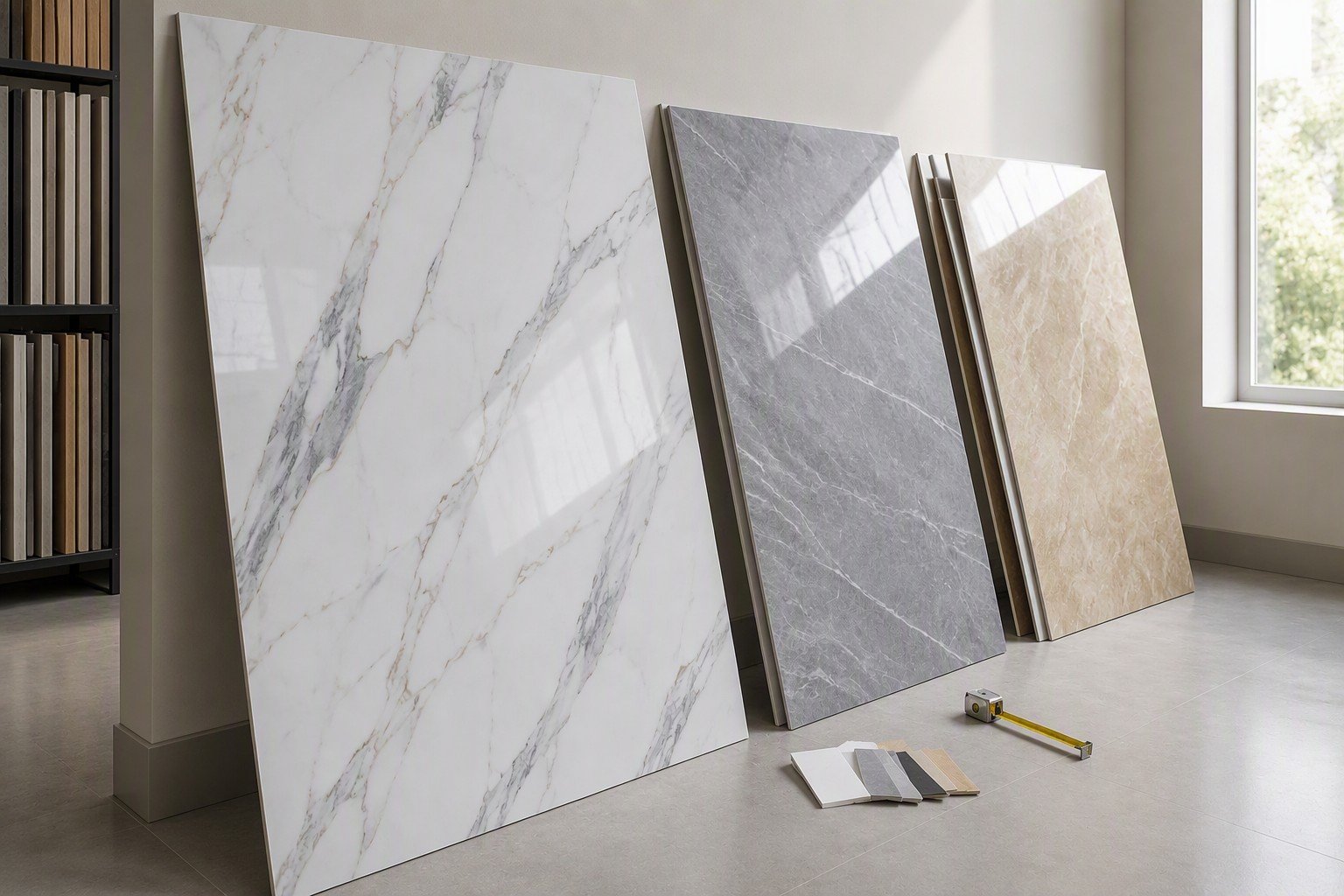
A UV marble sheet can expand a decorative wall product range, but a poor specification can create installation complaints, excess inventory, and unexpected freight costs. I often see buyers focus on patterns before confirming the application. A safer approach is to evaluate construction, finish, quality controls, pricing variables, and supplier reliability together.
A UV marble sheet is a decorative panel designed to provide a marble-inspired wall finish without serving as a complete substitute for natural marble[1]. Buyers should match the sheet to the installation area, wall condition, market expectations, order volume, and delivery terms. They should also verify samples, specifications, packaging, bulk consistency, and landed cost before ordering.
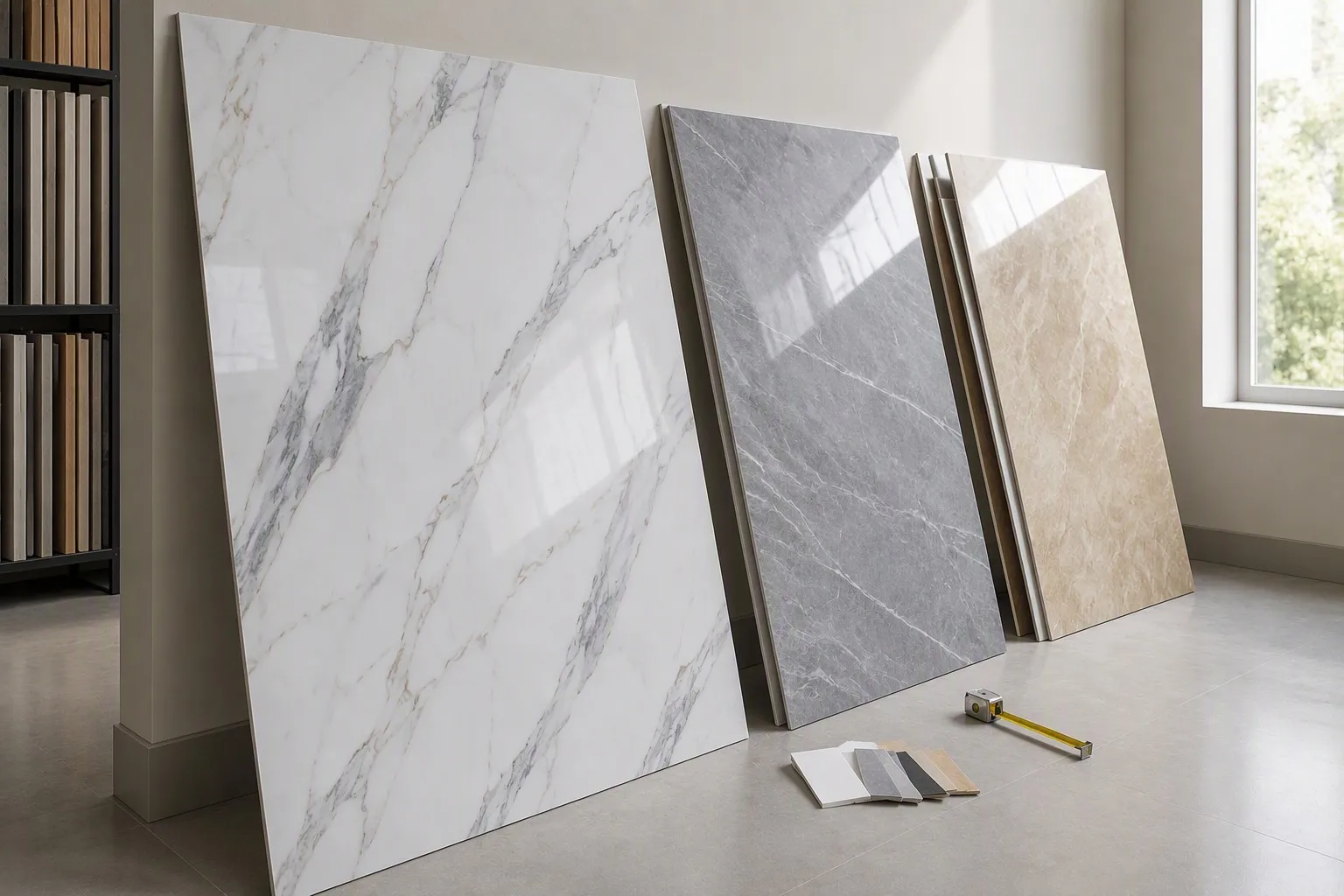
Based on my experience handling quotations, samples, customization, and export coordination, the most successful orders begin with practical questions rather than décor selection. The following sections explain how I assess product suitability, compare quality, calculate purchasing costs, and structure wholesale orders.
What Benefits Does a UV Marble Sheet Offer?
A buyer may be attracted by a polished marble pattern, but appearance alone cannot confirm whether a panel suits a project or resale market. If the application is unclear, even an appealing product can become difficult to install or sell. I therefore start by defining the task the panel must perform.
A UV marble sheet offers a consistent decorative surface, a broad choice of printed stone-inspired patterns, and practical panel-format installation for suitable interior wall applications. It can help importers and contractors achieve a coordinated visual effect, but buyers must verify the substrate, surface finish, installation method, environmental conditions, and applicable local requirements.

I Treat It as a Task-Specific Decorative Panel
I do not present UV panels as identical to quarried marble. Natural stone and manufactured decorative sheets have different constructions, installation methods, maintenance requirements, visual characteristics, and commercial positions.
I find that the comparison becomes more useful when buyers ask, “What job does this product need to do?” rather than, “Is this the same as marble?”
Common purchasing objectives include:
-
Creating a marble-inspired feature wall
-
Updating commercial interiors with large decorative panels
-
Offering coordinated patterns through a wholesale catalogue
-
Reducing the handling complexity associated with heavy stone products
-
Supporting repeatable décor selection across multiple rooms
-
Developing an OEM or private-label wall panel collection
-
Combining decorative panels with trims and other interior materials
The precise benefits depend on the ordered construction and the installation environment. I recommend that buyers request documented specifications instead of relying on general product descriptions.
I Ask About the Installation Area First
Before I recommend a construction or finish, I normally ask several diagnostic questions:
-
Where will the sheet be installed?
-
Is the project residential, hospitality, retail, office, or another commercial setting?
-
What is the existing wall surface?
-
Is the wall flat, clean, dry, and structurally suitable?
-
Will the area experience moisture, heat, impact, or intensive cleaning?
-
What adhesive and edge-finishing method will the installer use?
-
Which local building, fire, or emissions requirements apply?
These questions protect both the supplier and buyer. A decorative sheet that works in one interior area may not be appropriate for another. Any application involving unusual heat, persistent moisture, external exposure, fire-rated assemblies, or regulated public spaces should receive qualified professional review.
I treat product certificates and test reports as documents for verification, not as universal proof that every specification is suitable for every project.
Benefits Should Be Compared Against Project Priorities
| Purchasing priority | Potential value of UV panels | What I recommend verifying |
|---|---|---|
| Decorative variety | Multiple marble-inspired colours and patterns may be available | Physical samples, colour references, and current décor availability |
| Large-format appearance | Panels can reduce the number of visible surface divisions | Sheet dimensions, joint layout, wall measurements, and cutting plan |
| Repeat ordering | Standard products may support replenishment | Batch controls, décor continuity, and lead time |
| Wholesale display | Sample books and compact displays can support selection | Sample format, pattern coding, branding, and display costs |
| Installation planning | Panel formats may simplify suitable wall-covering work | Substrate preparation, adhesive compatibility, trims, and installer guidance |
| Private labelling | Packaging and labels may be customizable | MOQ, artwork, production feasibility, and approval process |
I advise buyers to rank these priorities before requesting a quotation. That short exercise usually produces a more relevant specification and prevents the conversation from becoming a pattern catalogue review with no clear purchasing criteria.
How Should Buyers Evaluate UV Marble Sheet Quality?
The word “quality” causes problems when buyers and suppliers define it differently. One buyer may mean gloss consistency, while another means thickness tolerance, protective packaging, or matching between batches. I reduce this risk by turning quality expectations into written, order-specific criteria that both parties can compare.
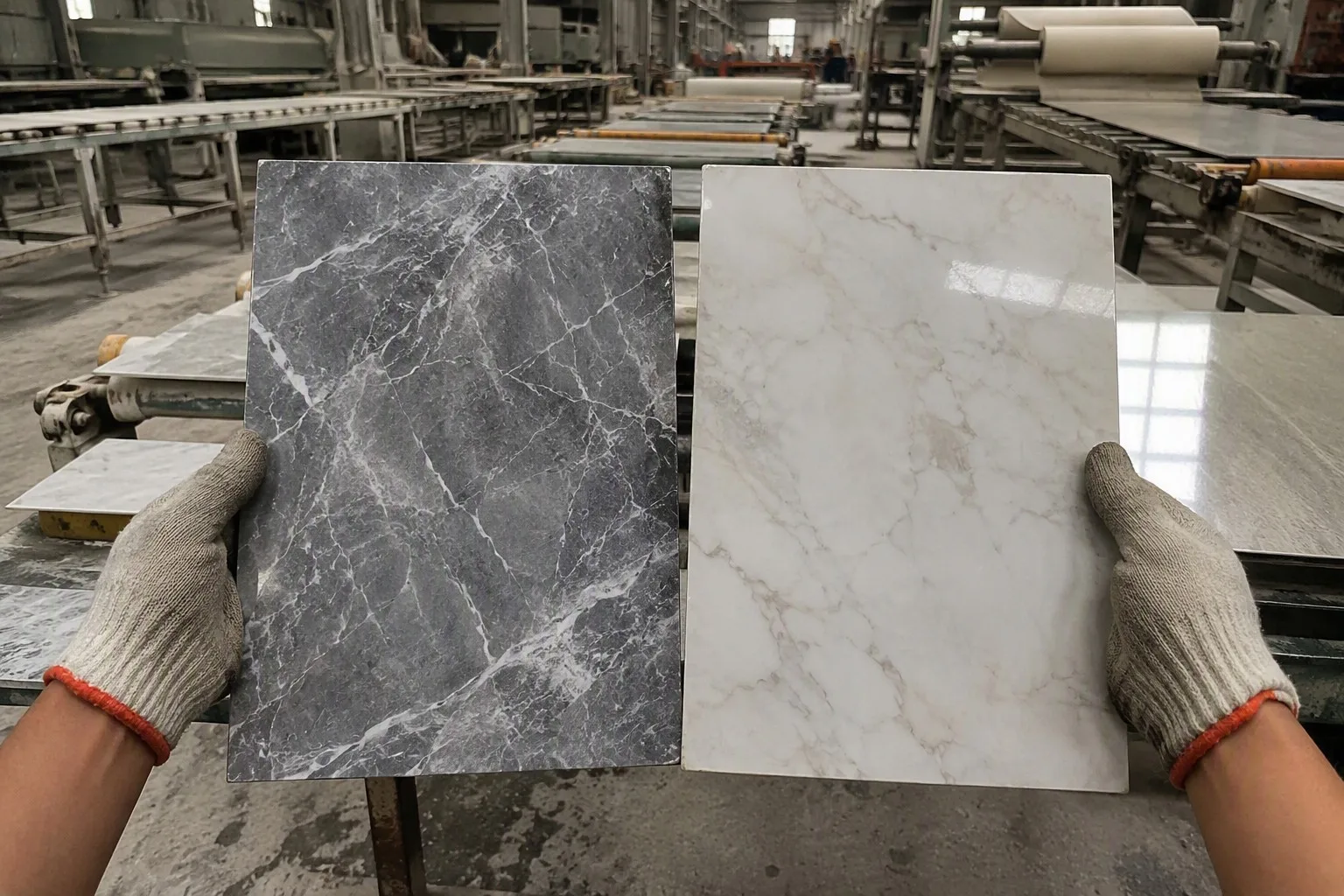
Buyers should evaluate UV marble sheet quality through an approved sample, confirmed product construction, measurable dimensions, finish requirements, visual acceptance standards, packaging details, and a bulk inspection plan. They should record approved décor codes and tolerances in the purchase order while verifying any test reports required for their destination or application.
I Define the Specification Before Discussing Grade
Labels such as “premium,” “A grade,” or “export quality” are not enough on their own. Suppliers may use those terms differently. I prefer a specification sheet that identifies what is actually being purchased.
Depending on the product, buyers may need to confirm:
-
Overall length and width
-
Nominal thickness and accepted tolerance
-
Substrate or core construction
-
Surface finish and gloss level
-
Décor code and colour reference
-
Back-surface condition
-
Edge condition
-
Protective film requirements
-
Sheet weight or packing weight
-
Pieces per carton or pallet
-
Packing materials and corner protection
-
Label, barcode, and private-brand requirements
The relevant criteria vary by order. Buyers should not assume that two visually similar panels have the same construction or performance.
I Use an Approved Sample as a Reference
A sample gives the buyer and supplier a shared reference, but it must be identified correctly. I recommend recording the sample date, décor code, finish, dimensions, construction, and supplier reference number. A small sample may not show the full pattern repeat or colour distribution of a full sheet, so buyers should request larger samples when décor scale is commercially important.
A reliable approval process usually follows these steps:
-
I confirm the intended application and target market.
-
The buyer selects preliminary patterns and specifications.
-
The supplier prepares identified samples.
-
The buyer reviews colour, finish, construction, and commercial suitability.
-
Both sides record the approved version.
-
The purchase order references that approval.
-
Production and inspection use the same agreed criteria.
Digital images are useful for initial selection, but screens, lighting, cameras, and compression can alter colour[2]. I therefore do not recommend using online images as the only colour standard.
Bulk Inspection Should Match the Purchase Order
A practical inspection plan can include incoming material checks, in-process reviews, final visual inspection, dimensional sampling, quantity verification, and packaging inspection. The exact method should reflect the order value and risk level.
| Inspection point | Questions I would include |
|---|---|
| Identification | Does the décor code match the purchase order and approved sample? |
| Dimensions | Are length, width, and thickness within agreed tolerances? |
| Surface | Are scratches, contamination, obvious printing defects, or finish irregularities within the acceptance standard? |
| Colour | Is the batch consistent within the agreed visual reference? |
| Edges | Are edges suitable for the planned cutting and installation method? |
| Protective layer | Is the film present and applied as specified? |
| Quantity | Do carton and total piece counts match the documents? |
| Packaging | Can the packaging support the planned handling and shipping route? |
| Labels | Are product codes, quantities, marks, and barcodes correct? |
For larger or higher-risk orders, buyers may appoint an independent inspection company. Buyers should agree on the sampling method and acceptance criteria before production rather than after a disagreement occurs.
Our factory operates under an ISO-certified management system, but I still advise buyers to verify the certificate’s issuing body, validity, scope, legal entity, and site coverage. An ISO certificate does not replace product-specific inspection or application-specific technical evaluation[3].
What Determines UV Marble Sheet Pricing?
A low unit quotation can become expensive when packaging, unusable loading space, inland transport, duties, or local delivery are added. I have seen many inquiries that request only a price per sheet without providing dimensions, quantity, destination, or trade terms. That information is not sufficient for a meaningful comparison.
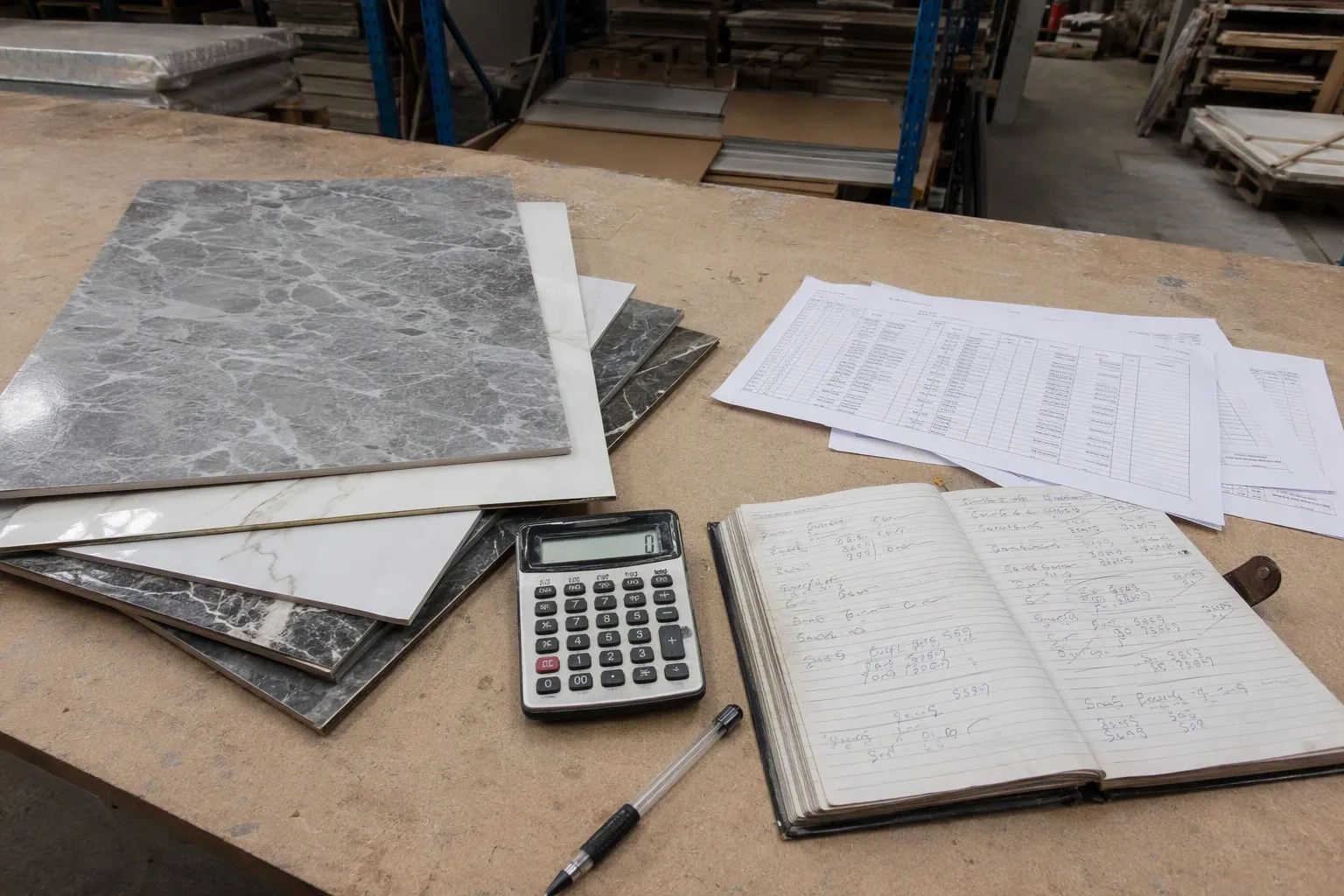
UV marble sheet pricing depends on sheet dimensions, construction, thickness, finish, quantity, pattern selection, customization, packaging, container utilization, destination, shipping method, and Incoterms. Buyers should compare dated quotations using the same specification, currency, quantity, and trade term, then calculate landed cost rather than choosing the lowest unit price alone.
I Build Quotations from Defined Variables
I avoid publishing a universal price range because it can quickly become misleading. Material costs, freight rates, exchange rates, and order requirements change. More importantly, a price has little meaning if the underlying specification is unknown.
A complete quotation request should state:
-
Product dimensions and thickness
-
Required surface finish
-
Décor codes or estimated décor mix
-
Order quantity by pattern
-
Packaging requirements
-
OEM label or carton requirements
-
Sample or display requirements
-
Destination port or full delivery address
-
Preferred shipping method
-
Required trade term
-
Target delivery schedule
-
Currency for quotation
Our usual minimum order quantity can start from 30 pieces, depending on the product and customization. Our lead time for many standard orders is generally 7–14 days, but I confirm both points for each quotation. Décor availability, packaging development, order size, production scheduling, and shipping arrangements can change the final plan.
Price Variables Affect Cost in Different Ways
| Pricing variable | How it may affect the quotation | Buyer action |
|---|---|---|
| Sheet dimensions | Larger formats change material use, handling, and loading | Confirm finished size and cutting needs |
| Construction and thickness | Different specifications have different material costs | Compare like with like |
| Surface finish | Finish processes may change production cost | Approve a physical finish sample |
| Quantity | Volume can affect setup and per-unit allocation | Request trial-order and volume options |
| Décor mix | Many low-volume patterns can complicate planning | Balance variety with saleable depth |
| Customization | New labels, cartons, patterns, or sizes may require setup | Confirm MOQ, fees, and approval steps |
| Packaging | Stronger or branded packing adds material and labour | Match packing to transport risk |
| Container utilization | Poor loading efficiency raises freight per sheet | Request loading quantity estimates |
| Trade term | EXW, FOB, CIF, and DDP include different responsibilities[4] | Compare the same Incoterm and location |
| Destination | Freight, duties, taxes, and local charges vary | Calculate destination-specific landed cost |
I Calculate Landed Cost, Not Just Factory Price
A simplified landed-cost model is:
Product value + export packing + origin transport and charges + international freight + insurance + import duty + taxes + customs fees + destination handling + local delivery = estimated landed cost
The exact calculation depends on the chosen Incoterm and local regulations. For example, an FOB quotation typically places different costs and responsibilities on the buyer than a CIF or DDP quotation. Buyers should review the current Incoterms® rule, named place, and contract wording[5] rather than relying only on the three-letter abbreviation.
Container planning also matters. A panel may have a competitive factory price but a poor freight cost per saleable unit if its dimensions, pallet configuration, or weight limit prevent efficient loading. I therefore ask for the expected quantity, pattern mix, packaging method, and destination before proposing an order structure.
Import duties, anti-dumping measures, taxes, product classifications, and documentation requirements can change by market[6]. Buyers should verify the applicable tariff classification and import obligations with a licensed customs broker or qualified trade professional[7].
How Should UV Marble Sheets Be Selected for Wholesale Applications?
Wholesale selection becomes risky when a buyer orders too many patterns with too little stock behind each one. The opposite problem also occurs when a buyer commits heavily to a narrow décor range before testing local demand. I prefer to match assortment depth, order size, and replenishment planning to the buyer’s actual sales model.
For wholesale applications, buyers should choose UV marble sheets according to customer type, local décor preferences, installation expectations, inventory capacity, and replenishment speed. Importers need balanced assortments and efficient container plans, project contractors need schedule and batch control, while OEM buyers must confirm customization feasibility, approval steps, MOQ, and packaging requirements.
Importers and Distributors Need a Saleable Décor Mix
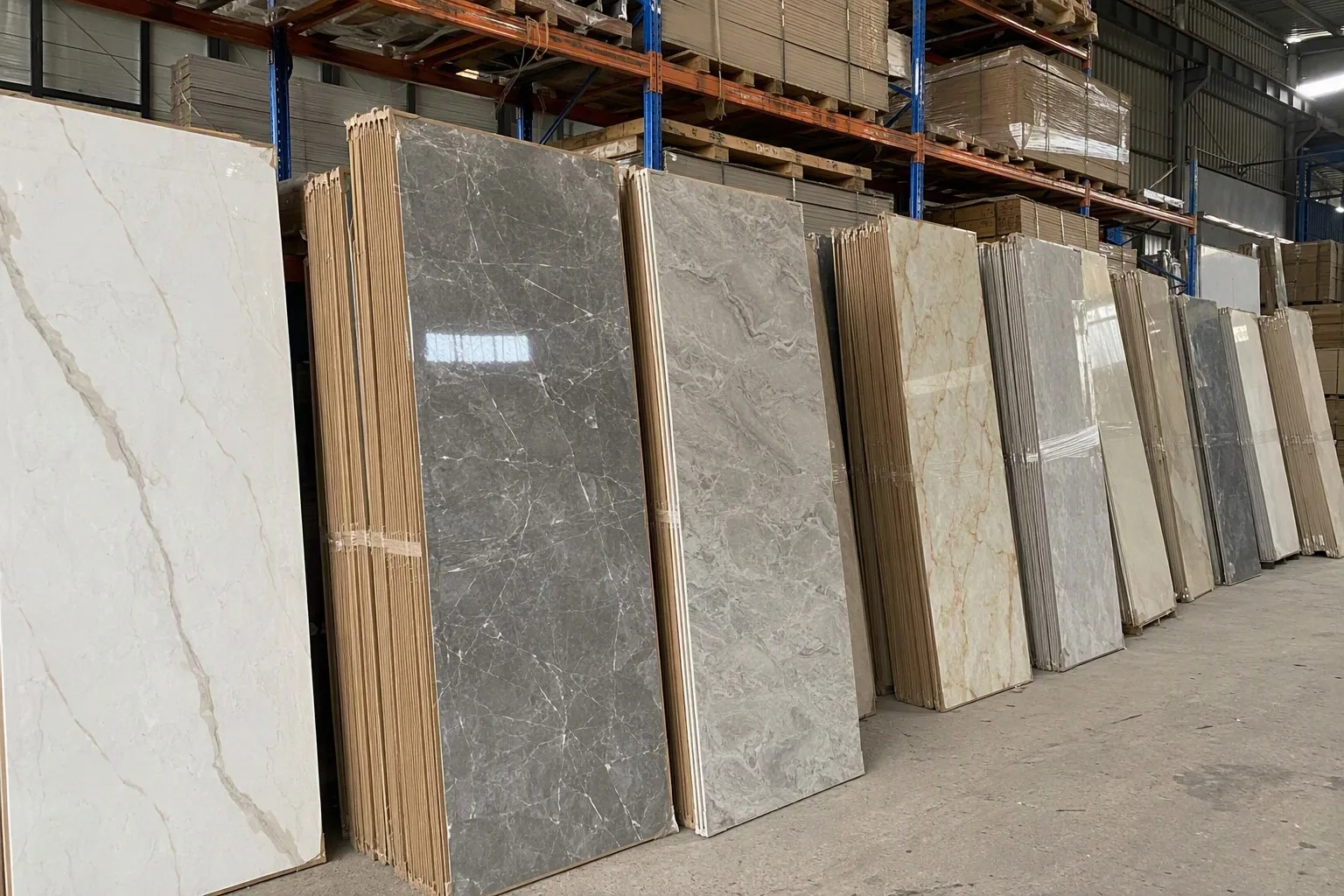
A wholesale collection should reflect regional preferences rather than the supplier’s entire catalogue. I usually ask buyers which marble tones already sell in their market and how customers select products. Some distributors need neutral, easy-to-coordinate options. Others require dramatic patterns for feature walls or hospitality displays.
A trial assortment can include:
-
Core neutral patterns for broad commercial appeal
-
Warm-toned options for selected regional preferences
-
High-contrast designs for statement walls
-
A controlled number of trend-led patterns
-
Replacement stock for the strongest expected sellers
The right proportions depend on actual sales data. I do not claim that one décor mix will work in every country.
A small importer should also consider whether each pattern can achieve enough sales velocity. Too many stock-keeping units can divide limited capital and warehouse space[8]. A narrower initial collection may produce clearer demand data and simpler replenishment[9].
Project Buyers Need Application and Schedule Control
Contractors, developers, and hospitality procurement teams often have different priorities from wholesalers. A project buyer may need a particular appearance across a defined area, delivered within a construction schedule.
I recommend that project buyers confirm:
-
Total measured wall area
-
Cutting allowance and expected waste
-
Sheet orientation and pattern layout
-
Batch and colour consistency requirements
-
Installation sequence
-
Delivery milestones
-
Storage conditions on site
-
Replacement-sheet allowance
-
Required technical documents
-
Responsibility for installation approval
The buyer’s architect, installer, or qualified project professional should approve application details. I can support product selection and manufacturing coordination, but I do not replace site engineering or installation expertise.
OEM Buyers Need Feasibility Checks
OEM and private-label programs may include customized dimensions, finishes, cartons, labels, barcodes, inserts, or décor development. However, no supplier should promise unlimited customization without checking machinery, materials, minimum quantities, tooling, artwork, and compliance requirements.
| Buyer model | Main purchasing priority | Key risk to control |
|---|---|---|
| Importer | Landed cost and container efficiency | Hidden logistics costs |
| Wholesaler | Saleable assortment and replenishment | Excess slow-moving inventory |
| Local distributor | Display support and manageable MOQ | Too many low-volume patterns |
| Contractor | Application fit and delivery schedule | Mismatched batch or project delay |
| Hospitality buyer | Approved appearance and documentation | Specification changes after approval |
| OEM brand | Consistent branding and packaging | Artwork errors or unrealistic customization |
| E-commerce seller | Pack integrity and clear product information | Transit damage and customer expectation gaps |
I suggest using an approval checklist for every custom element. The buyer should approve artwork dimensions, colours, text, carton marks, barcode data, and sample placement before mass printing.
How Can Buyers Compare UV Marble Sheet Suppliers?
A polished catalogue does not show how a supplier controls specifications, communicates changes, or handles export documents. Supplier selection becomes more difficult when buyers compare only pattern count and unit price. I recommend evaluating the complete order process, from inquiry response through inspection, shipping, and after-sales communication.
A reliable UV marble sheet supplier should provide traceable specifications, identifiable samples, realistic production schedules, clear customization limits, documented quality controls, and transparent shipping terms. Buyers should verify the factory identity, business documents, certificate scope, export experience, packaging methods, inspection process, and response procedure for non-conforming goods.
I Review Communication Before Production
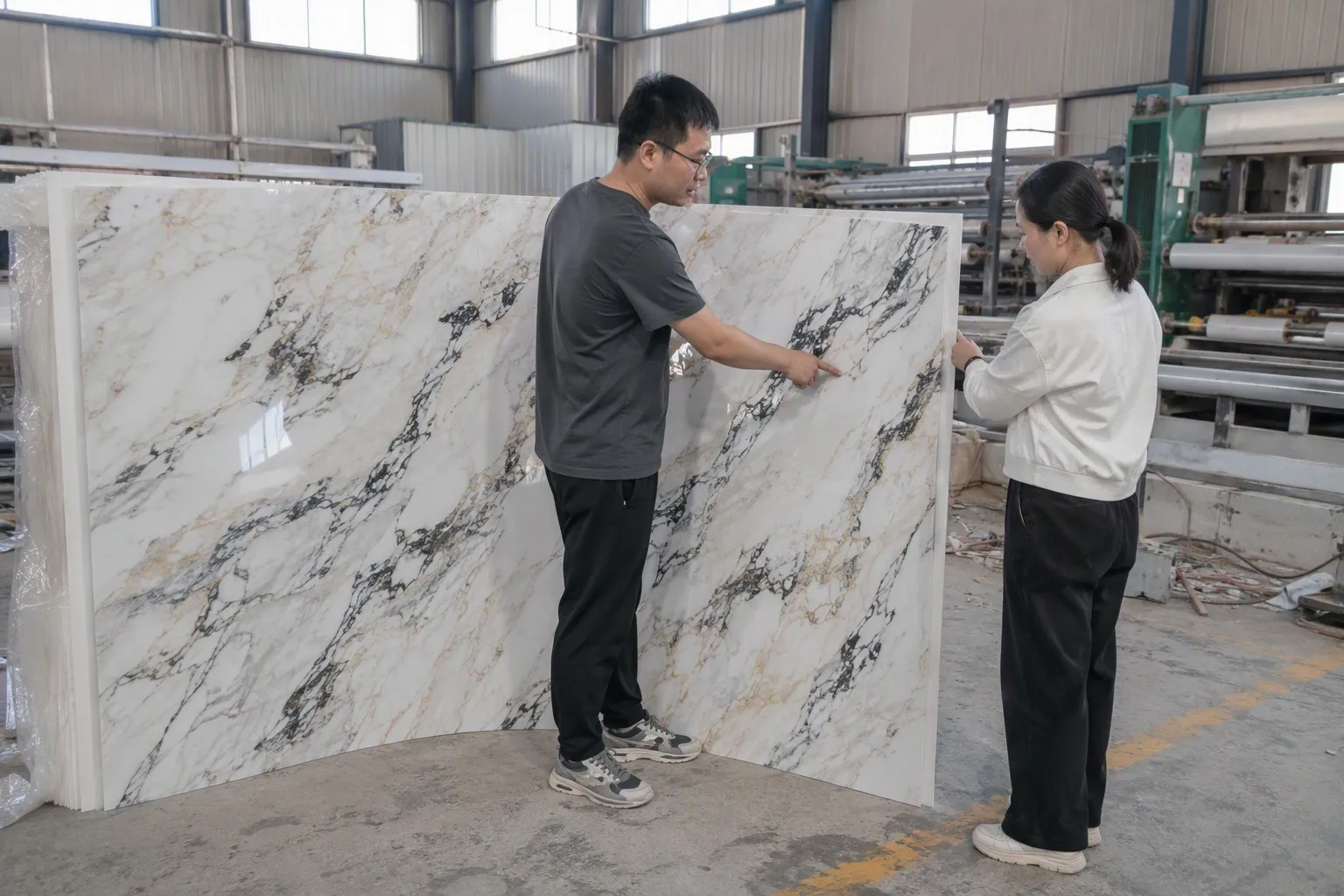
Early communication often indicates how a supplier will manage the order later. A useful supplier should ask about application, quantity, destination, packaging, and target market before recommending a product.
I become cautious when a supplier:
-
Gives a firm price without confirming specifications
-
Claims that one panel suits every installation
-
Refuses to identify sample codes
-
Uses vague grade descriptions without measurable criteria
-
Promises any customization at any quantity
-
Avoids discussing packaging or loading
-
Cannot explain the quotation’s trade term
-
Provides certificates that do not match the company or product
-
Will not define a complaint or replacement process
Good communication does not guarantee perfect production. However, documented answers reduce ambiguity and create a better basis for accountability.
I Use a Structured Supplier Scorecard
| Evaluation area | Suggested questions |
|---|---|
| Company verification | Does the legal company name match contracts, bank details, and certificates? |
| Manufacturing | Which processes are completed in-house, and which are outsourced? |
| Specification control | Can the supplier issue a clear product data sheet? |
| Samples | Are samples coded, dated, and traceable? |
| Quality control | What checks occur before, during, and after production? |
| Batch management | How does the supplier control décor and finish consistency? |
| Packaging | Has the packing method been defined for the shipping route? |
| Capacity | Is the proposed lead time realistic for the order volume? |
| Export support | Can the supplier coordinate the agreed documents and shipping term? |
| After-sales process | How must the buyer document shortages, damage, or non-conformity? |
Our team supports FOB, CIF, and DDP arrangements where feasible, and we work with buyers across more than 50 countries. I still recommend that every buyer confirm the named port or place, included charges, shipping assumptions, and import responsibilities in writing.
Buyers who want face-to-face discussions can also meet suppliers at established trade fairs. We regularly exhibit at the Canton Fair, Dubai Big 5, and Paris Builders Show. A trade-show meeting can support initial assessment, but buyers should still conduct document checks, sample approval, and order-specific quality control.
Frequently Asked Questions
Is a UV marble sheet the same as natural marble?
No. A UV marble sheet is a manufactured decorative panel with a marble-inspired appearance. Natural marble is quarried stone[10] with different material properties, variation, weight, installation methods, and maintenance needs. I recommend positioning the sheet as a task-specific decorative solution rather than claiming full equivalence to stone.
What information should I provide for a wholesale quotation?
I recommend providing dimensions, thickness, construction, finish, décor mix, quantity, packaging, customization, destination, shipping method, currency, and required Incoterm. A supplier also needs the intended application and target delivery date. These details make quotations more comparable and reduce later price changes.
Can I approve UV marble sheets from photos alone?
I do not recommend final approval from photos alone. Screens and lighting can change the apparent colour, gloss, and contrast. Buyers should review an identified physical sample and record its décor code, construction, finish, and date. Large pattern scale may also require a full-sheet image or larger sample.
What documents should an importer verify?
Importers may need a commercial invoice, packing list, bill of lading, certificate of origin, and destination-specific compliance documents[11]. Requirements vary by product and country. Buyers should verify certificate validity and scope, then consult a customs broker or qualified compliance professional before shipment.
How much extra material should a project buyer order?
The allowance depends on wall dimensions, sheet size, pattern direction, cutting layout, installation method, and replacement needs. I avoid using one percentage for every project. A qualified installer or estimator should calculate waste, while the buyer should consider retaining matching sheets for future replacement.
Conclusion
A UV marble sheet purchase should balance appearance with application fit, measurable quality criteria, landed cost, inventory planning, and supplier capability. I recommend starting with wall conditions and customer needs, then approving a traceable sample and documenting the bulk-order standard. Buyers should also compare quotations on identical terms and verify relevant certificates through qualified professionals. If you are sourcing for distribution, contracting, or private labelling, contact our team for samples, specification options, MOQ guidance, container planning, and an order-specific FOB, CIF, or DDP quotation.
References
-
“Marble”, https://en.wikipedia.org/wiki/Marble. Natural marble is a naturally occurring metamorphic stone, whereas decorative wall sheets are manufactured products with different composition, fabrication, and installation characteristics. Evidence role: general_support; source type: encyclopedia. Supports: Natural marble is a natural stone with geological composition and physical characteristics distinct from manufactured decorative panels. Scope note: This distinction supports the general comparison but does not evaluate the performance of a particular UV marble sheet.
-
“Color Error in the Digital Camera Image Capture Process - PMC”, https://pmc.ncbi.nlm.nih.gov/articles/PMC3948926/. Colour appearance in photographed and displayed images depends on capture conditions, illumination, display calibration, and colour-management workflows; therefore, digital images alone are not a reliable physical colour standard. Evidence role: mechanism; source type: institution.
-
“ISO - Certification”, https://www.iso.org/certification.html. ISO management-system certification concerns the conformity of an organization’s management system; it is distinct from product certification and does not by itself demonstrate that a particular product is suitable for a particular end use. Evidence role: definition; source type: institution.
-
“Know Your Incoterms”, https://www.trade.gov/know-your-incoterms. The ICC Incoterms® rules define different delivery terms that allocate transport obligations, costs, and transfer of risk between seller and buyer in different ways. Evidence role: definition; source type: institution.
-
“Know Your Incoterms”, https://www.trade.gov/know-your-incoterms. ICC guidance on Incoterms® use emphasizes specifying the selected rule, the applicable edition, and the named place or port, because these details determine the practical allocation of delivery obligations. Evidence role: general_support; source type: institution.
-
“UNCTAD Coding System of Trade Control Measures”, https://wits.worldbank.org/WITS/docs/UNCTAD%20Coding%20System%20of%20Trade%20Control%20Measures.docx. Import tariff treatment, customs classification, trade-remedy measures, taxes, and documentary requirements are governed by the rules of the importing jurisdiction and may differ across markets. Evidence role: general_support; source type: institution.
-
“Harmonized System (HS) Codes”, https://www.trade.gov/harmonized-system-hs-codes. Customs authorities treat tariff classification as a core element of import declaration because it can determine applicable duties, restrictions, and documentary obligations; importers may therefore need qualified customs advice or a formal ruling. Evidence role: general_support; source type: government.
-
“Tackle Your Supply Chain Challenges - SCM”, https://scm.mit.edu/tackle-your-supply-chain-challenges-2/. Inventory-management research indicates that expanding product variety can increase operational complexity and spread working-capital investment across a larger number of stock-keeping units. Evidence role: mechanism; source type: research.
-
“A Demand Estimation Procedure for Retail Assortment”, https://faculty.wharton.upenn.edu/a-demand-estimation-procedure-for-retail-assortment-optimization-with-results-from-implementations-workingpaper-file-file/. Research on retail assortment and inventory management shows that the number of items offered can affect forecasting accuracy, inventory allocation, and replenishment complexity. Evidence role: general_support; source type: paper.
-
“Marble”, https://en.wikipedia.org/wiki/Marble. Marble is a metamorphic rock used as dimension stone and is commonly obtained by quarrying natural rock deposits. Evidence role: definition; source type: government.
-
“Common Export Documents”, https://www.trade.gov/common-export-documents. Customs and trade guidance identifies commercial invoices, packing lists, transport documents such as bills of lading, and certificates of origin among documents commonly required or requested in international trade. Evidence role: general_support; source type: government.