
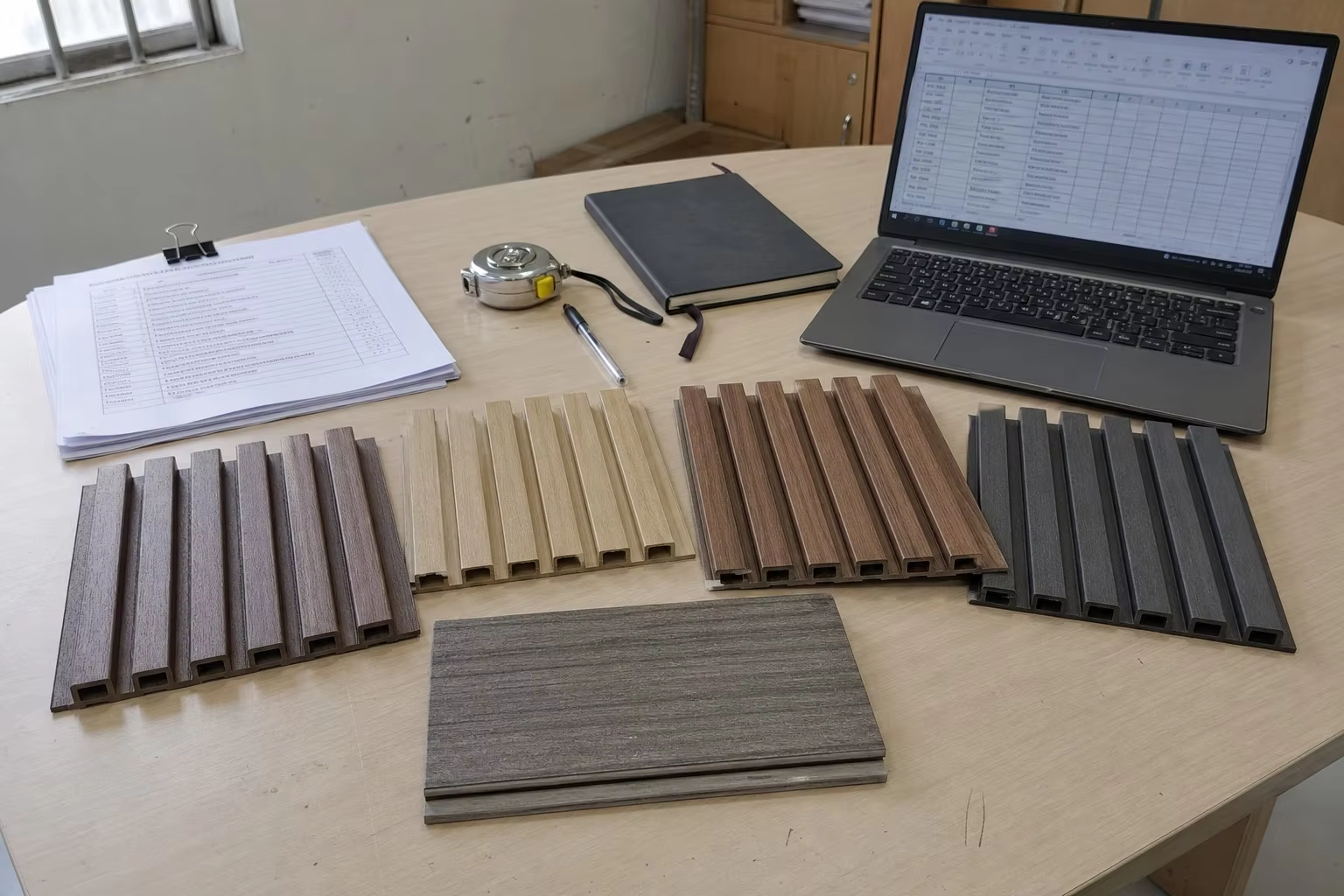
Importing WPC wall panels from China can expose buyers to specification errors, misleading price comparisons, and costly delivery surprises. Those risks grow when purchasing starts with a price request instead of a clear brief. I use a ten-step sourcing process to help buyers compare suitable products, capable suppliers, and realistic landed costs.
To import WPC wall panels from China, I recommend defining the application and specifications first, shortlisting verified suppliers, normalizing quotations, approving samples, confirming quality controls, signing clear purchase terms, inspecting production, arranging shipping, checking delivered goods, and documenting after-sales procedures. Each step reduces a different commercial, technical, or logistics risk.
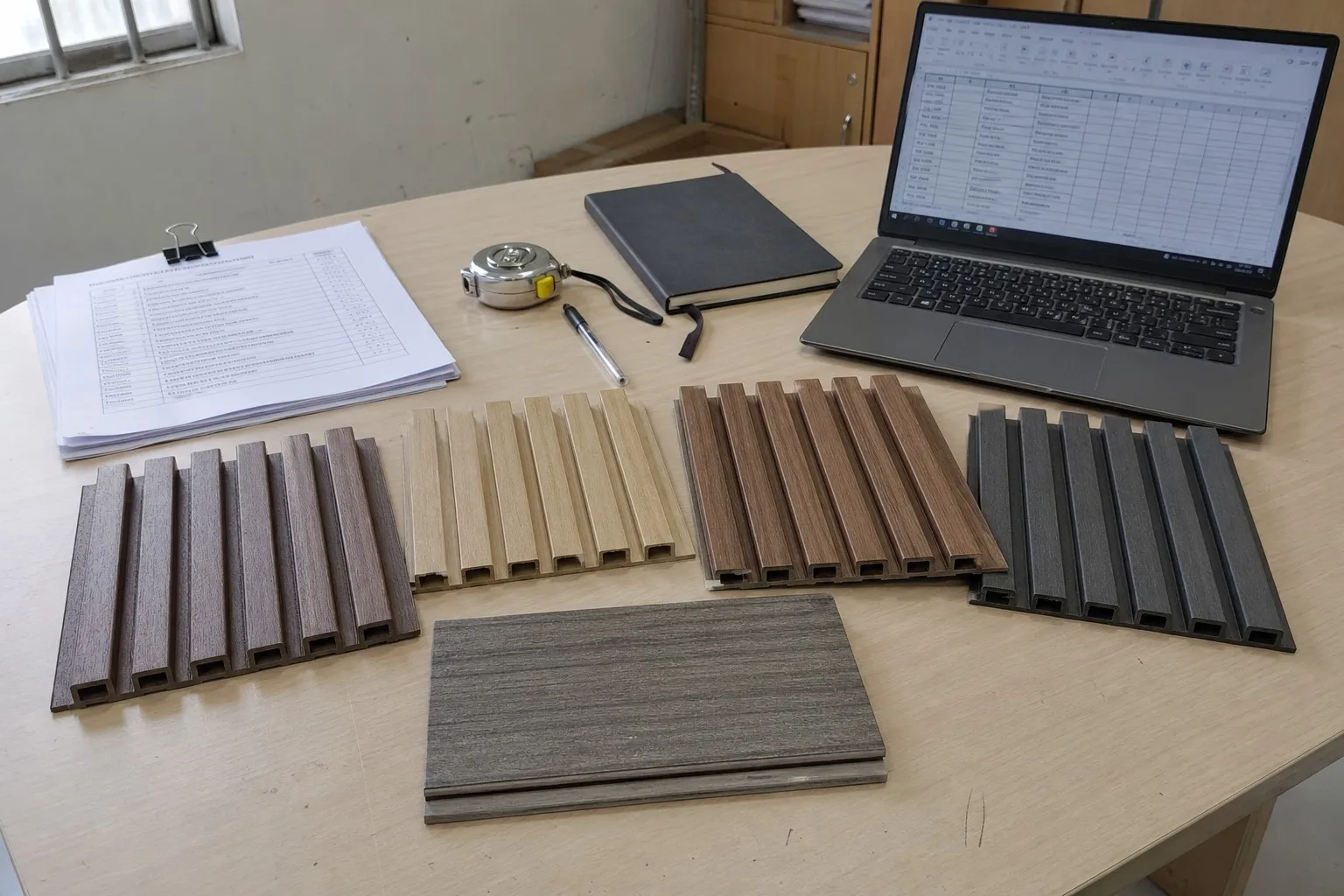
I do not treat these ten steps as a universal formula. Every destination market and project creates different requirements. However, the process gives importers, distributors, contractors, and design firms a practical framework for asking the right questions before money, materials, and deadlines are committed.
How Do Steps 1–2 Define the WPC Wall Panel Purchase Brief?
An incomplete inquiry creates an immediate problem. A supplier may quote a product that looks suitable but does not match the installation environment, quantity, or destination. I prevent that mismatch by defining the application first and converting the buyer’s requirements into a written purchase brief.
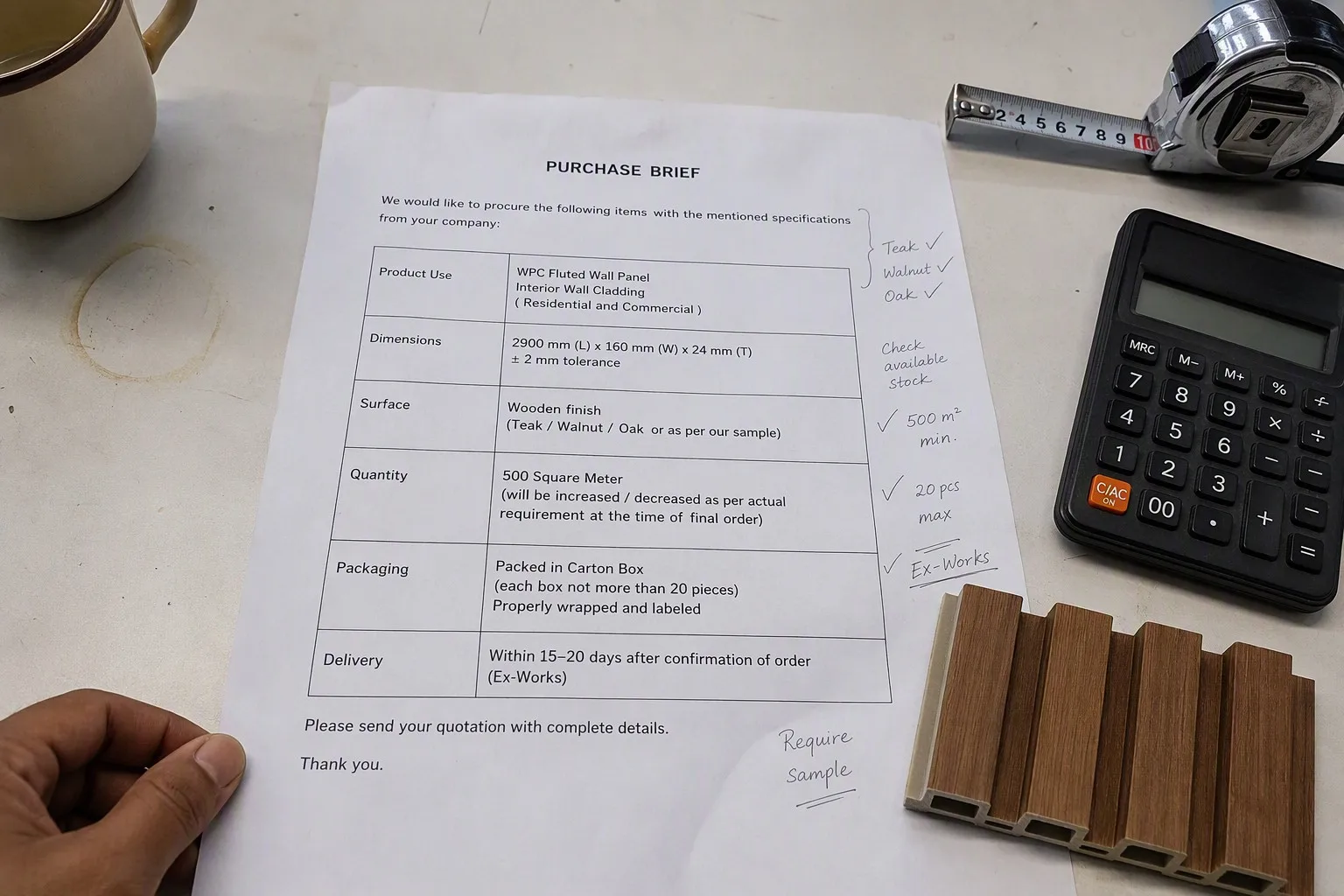
Steps 1 and 2 are to identify the intended application and document the complete purchasing requirement. I confirm indoor or outdoor use, market requirements, installation conditions, dimensions, finish, quantity, packaging, destination, schedule, and replenishment plan before I ask suppliers to submit comparable proposals.
Step 1: Define the application and target market
I start by asking where and how the panels will be used. The phrase “WPC wall panel” covers products with different profiles, finishes, formulations, installation methods, and intended environments. An indoor decorative fluted panel should not be evaluated as though it were exterior cladding.
I recommend answering these questions:
- Will the panels be installed indoors, outdoors, or in a semi-exposed area?
- Is the project residential, retail, office, hospitality, or another commercial setting?
- Will the panels face direct sunlight, rain, humidity, impact, or temperature changes?
- What substrate and fastening method will the installer use?
- Are matching trims, corner profiles, clips, or other accessories required?
- Which local fire, emissions, labeling, or building requirements may apply?
- Will the buyer resell the panels or use them in a defined project?
I can explain typical product options as a manufacturer, but I do not replace a local architect, engineer, laboratory, customs adviser, or code professional. Buyers should verify application-specific performance and destination-market requirements with qualified local parties.
Supplier certificates should also be treated as documents to examine, not automatic proof that a shipment complies with every local rule. I advise buyers to verify the issuing body, certificate scope, product identification, report date, tested standard, and whether the tested construction matches the ordered panel.
Step 2: Create a written purchase brief
I then turn the application information into a concise sourcing document. The brief should give each potential supplier the same information.
| Requirement | Information to specify |
|---|---|
| Product use | Indoor, outdoor, or semi-exposed |
| Profile | Drawing, photograph, or profile code |
| Dimensions | Length, width, thickness, and tolerances |
| Surface | Color, grain, texture, gloss, or reference sample |
| Quantity | Pieces, square meters, and expected order frequency |
| Accessories | Trims, clips, fasteners, adhesives, or other items |
| Packaging | Carton, pallet, labeling, barcode, and protection needs |
| Delivery | Destination port or full delivery address |
| Timing | Target order date and required arrival period |
| Trade basis | EXW, FOB, CIF, DDP, or another agreed Incoterm |
| Market documents | Requested reports, declarations, or labels |
| Replenishment | One-time project or recurring inventory program |
In my experience, this brief saves time because it reveals uncertainty early. It also creates the basis for later sample approval, inspection, and claims handling.
How Do Steps 3–4 Help You Import WPC Wall Panels from China at a Comparable Cost?
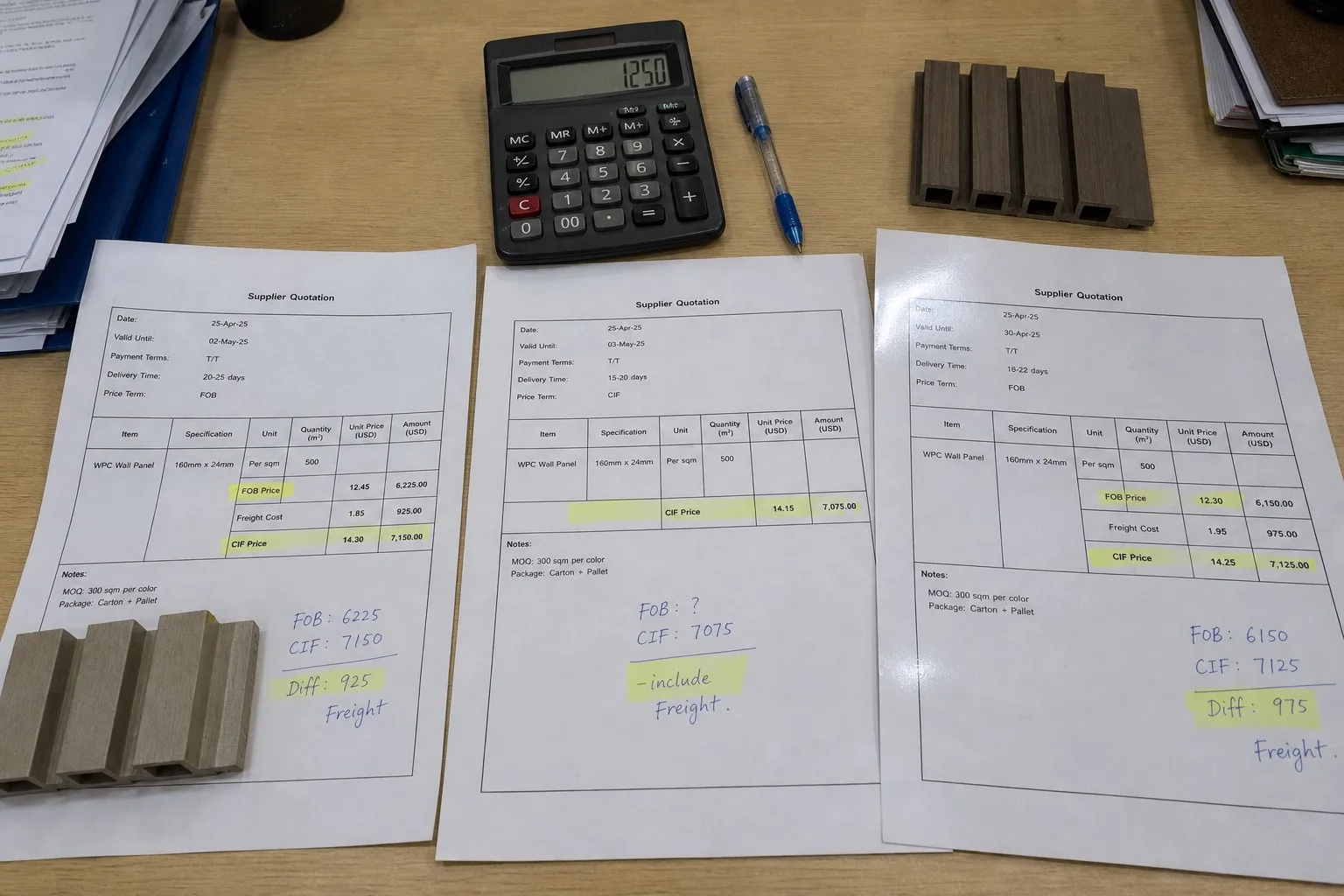
Price comparison becomes unreliable when suppliers quote different profiles, packaging methods, quantities, or delivery terms. I often see buyers focus on the unit price while overlooking loading efficiency and freight responsibility. That approach can make the apparently cheapest proposal more expensive or less suitable.
Steps 3 and 4 are to build a relevant supplier shortlist and normalize every quotation. I compare the same specification, quantity, packaging, accessories, Incoterm, and destination. I then separate the product price from tooling, documentation, inspection, inland transport, ocean freight, duties, and local delivery.
Step 3: Shortlist suppliers by capability
I recommend looking beyond catalog size. A large catalog does not prove that a factory can reproduce the approved panel consistently across a commercial order.
I ask each supplier to clarify:
- Which manufacturing operations take place in-house?
- Which processes or accessories are outsourced?
- What profiles, dimensions, colors, and finishes can be customized?
- What is the regular production capacity for the selected profile?
- What raw-material and process controls are documented?
- How are color and surface differences managed between batches?
- Which inspection points are used during production?
- How are panels protected during packing and container loading?
- Who handles technical questions and after-sales claims?
- Can the supplier support repeat orders with controlled references?
I also review the legal business identity, factory address, export experience, and relevant audit or quality-system records. Our own factory is ISO certified, but I still advise buyers to verify the certificate directly and confirm its scope. An ISO management-system certificate does not by itself certify every product or guarantee destination-market approval.[^1]
Video calls, third-party audits, and factory visits can provide additional evidence. Trade-show meetings can also help. We attend events such as the Canton Fair, Dubai Big 5, and Paris building exhibitions, but buyers should still perform the same documentary and product checks after meeting any supplier.
Step 4: Normalize quotations and estimate landed cost
A quotation marked EXW cannot be compared directly with FOB, CIF, or DDP.[^2] The included responsibilities are different.
| Quotation basis | Typical comparison issue |
|---|---|
| EXW | The buyer may need to arrange pickup, export handling, and all freight |
| FOB | The supplier generally delivers the goods on board at the named port |
| CIF | The quote includes cost, insurance, and freight to the named destination port |
| DDP | The quote may include delivery and import responsibilities, subject to the exact agreement |
I recommend checking the current Incoterms 2020 rule with a freight or trade professional. The sales contract should name both the rule and the place, such as “FOB named port, Incoterms 2020.” The three-letter term alone can leave room for disagreement.
I use a landed-cost worksheet with separate lines for:
- Product and accessory costs
- Sample and tooling charges
- Custom packaging and labeling
- Domestic transport in China
- Export handling and documentation
- Inspection fees
- Ocean, rail, air, or courier freight
- Cargo insurance
- Destination terminal charges
- Customs duty and taxes
- Customs brokerage
- Warehousing and final delivery
I once received an inquiry in which a buyer asked only for the WPC wall panel price. The buyer had not provided a quantity or Incoterm. I asked about the application, profile, dimensions, packaging, destination, order volume, delivery basis, and replenishment plan. Once those details were supplied, the buyer changed the preferred option because the original comparison had not included equivalent packaging and delivery responsibilities.
I do not use that case to claim guaranteed savings. It simply shows why quotation structure can change a purchasing decision.
How Do Steps 5–6 Verify WPC Wall Panel Samples and Supplier Quality?
An attractive sample can create false confidence. A supplier may prepare one good panel without demonstrating stable production across the full order. I reduce this risk by treating the sample as a controlled reference and evaluating the system used to reproduce it.
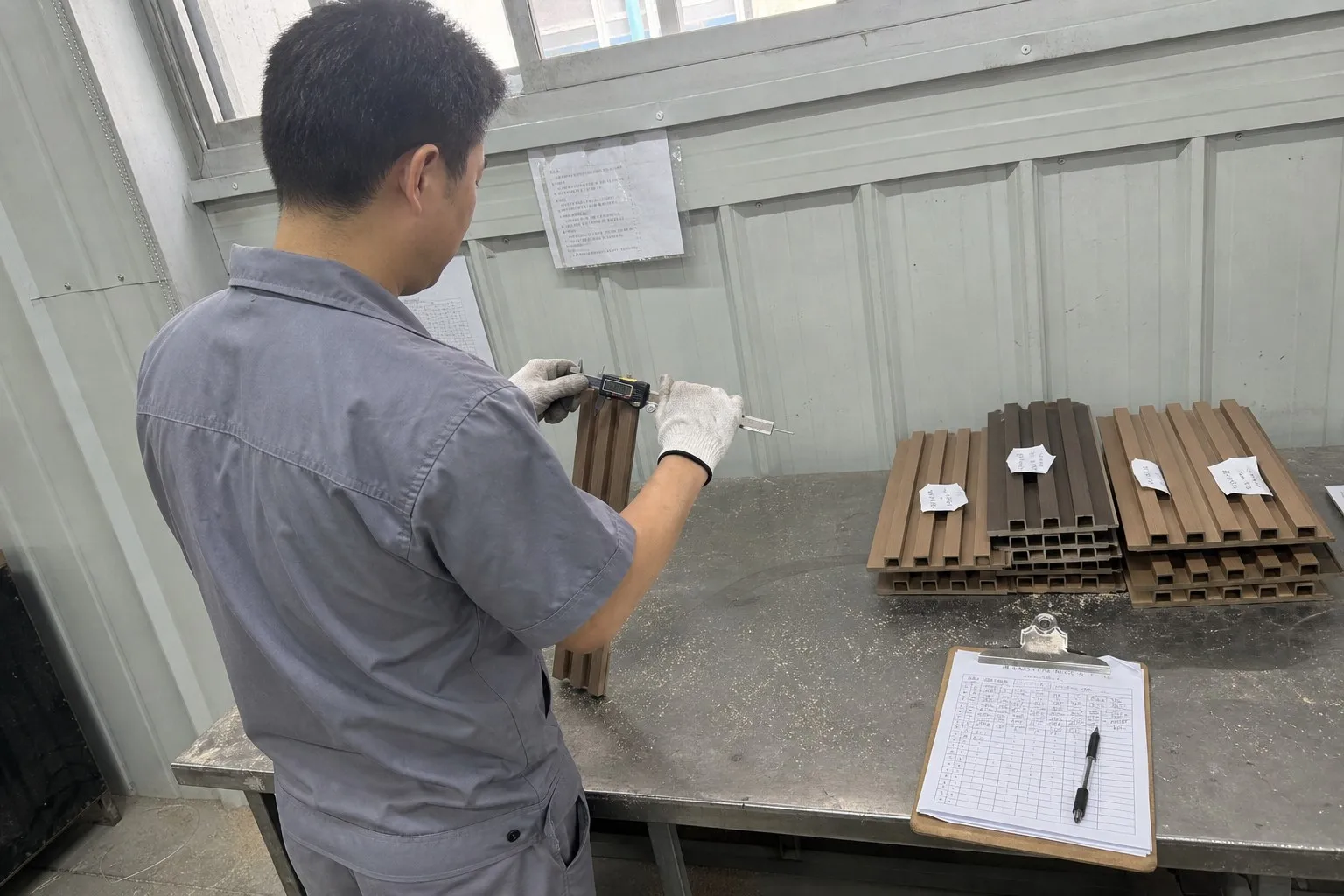
Steps 5 and 6 are to approve a documented sample and assess production quality controls. I compare dimensions, profile geometry, fit, finish, color, labeling, and packaging. I also confirm how raw materials, process settings, inspections, nonconforming goods, and retained samples will be managed during mass production.
Step 5: Evaluate samples and customization
I advise buyers to request the closest available standard sample before paying for extensive customization. A standard sample can help the buyer assess the supplier’s basic profile quality, surface finish, packing method, and communication.
The sample review should cover:
- Dimensions: Do the measured dimensions match the stated specification?
- Profile fit: Do tongue-and-groove joints, clips, or trims fit correctly?
- Surface: Are color, texture, gloss, and grain direction acceptable?
- Edges: Are the edges straight and free from obvious damage?
- Appearance: Are visible marks, dents, or irregularities present?
- Installation: Can the installer create a small mock-up?
- Packaging: Can the packing resist normal handling and transport?
- Identification: Is the sample linked to a clear code, date, and revision?
I prefer physical reference samples when appearance is commercially important. Screen colors and digital renderings can vary between devices. A signed or otherwise documented approval sample creates a clearer reference than messages such as “same as the picture.”
Customization also needs practical limits. A new profile may require tooling. A special color may require a production minimum. An unusual length may affect container loading, damage risk, or freight cost. I ask suppliers to state these effects before order confirmation.
Step 6: Review the quality-control plan
I ask the supplier to show how quality will be checked, rather than accepting a general statement such as “strict QC.”
A useful inspection plan can identify:
| Stage | Possible control points |
|---|---|
| Incoming materials | Supplier records, identification, color reference, and storage |
| Start of production | Profile dimensions, surface appearance, and machine settings |
| In-process checks | Length, width, fit, finish, visible defects, and batch references |
| Final inspection | Quantity, assortment, labels, accessories, and workmanship |
| Packing | Carton strength, separators, corner protection, pallet condition |
| Loading | Container condition, loading pattern, moisture precautions, and photos |
The precise tests and tolerances should depend on the product and application. I avoid inventing a universal acceptance limit because different panels, profiles, markets, and installation systems require different criteria.
Buyers can use their own inspector or an independent third-party inspection company. The purchase contract should state who selects the inspector, who pays, what sampling method applies, and what happens if the shipment does not meet the agreed criteria.
How Do Steps 7–8 Control the Order When You Import WPC Wall Panels from China?
Verbal agreement leaves critical details open to interpretation. Problems can emerge when the buyer and supplier understand the color, packaging, payment milestone, or completion date differently. I control that risk through written order terms and a pre-production confirmation process.
Steps 7 and 8 are to finalize a detailed purchase agreement and monitor production against the approved specification. I include product codes, drawings, tolerances, quantities, packaging, inspection rights, payment terms, Incoterms, completion conditions, and claim procedures. Production should begin only after controlled references are approved.

Step 7: Confirm the commercial agreement
I recommend using a purchase order or contract that connects every commercial promise to a measurable requirement. Buyers should seek qualified legal advice when the order value, destination rules, or contractual exposure justifies it.
The agreement should normally address:
- Legal names and contact details of both parties
- Product codes and profile drawings
- Approved colors, textures, and samples
- Dimensions and agreed tolerances
- Order quantity and permitted quantity variation
- Accessories and spare material
- Packaging, labels, barcodes, and marks
- Price and currency
- Named Incoterm and location
- Payment stages
- Production and inspection milestones
- Shipment window
- Required commercial and shipping documents
- Inspection and rejection procedures
- Warranty or claim process
- Responsibility for approved corrective action
I recommend verifying bank account details through a known communication channel. Buyers should be cautious if payment instructions change unexpectedly.[^3] A familiar-looking email address does not eliminate payment fraud risk.
Our normal business context includes lead times of 7–14 days on many products and minimum orders starting from 30 pieces for some items. However, I treat those figures only as initial supplier information. Actual lead time and MOQ depend on the profile, color, customization, raw-material availability, packing, order size, and production schedule. Buyers should obtain written confirmation for the specific order.
Step 8: Approve pre-production details and monitor output
Before full production, I confirm the final bill of materials, profile reference, finish, packaging, labels, and carton marks. For customized orders, I may use a pre-production sample or first-off production check.
I suggest creating clear checkpoints:
- Order confirmation: Both parties approve the specification and commercial terms.
- Material preparation: The supplier confirms the required inputs and references.
- First-off check: Early production pieces are checked before the full run continues.
- In-process review: The supplier records agreed measurements and appearance checks.
- Packing approval: The buyer confirms labels, cartons, and assortment.
- Final inspection: Goods are checked before the balance payment or shipment milestone.
Production updates should provide useful evidence. A photograph of one good panel does not show the condition of an entire order.[^4] I prefer dated photos, short production videos, batch references, packing records, and inspection reports tied to the purchase order.
Batch consistency deserves special attention when buyers plan repeat purchases. I advise keeping approved color references, profile drawings, order numbers, and retained samples. Natural visual variation or manufacturing variation may still exist, so acceptance criteria should be realistic and written.
How Do Steps 9–10 Complete the WPC Wall Panel Import Process?
The product can pass inspection and still arrive damaged or create a dispute. Weak packing, unclear shipping documents, poor container loading, and delayed claim evidence can undermine earlier work. I therefore treat dispatch and receipt as quality-control stages rather than administrative details.
Steps 9 and 10 are to inspect, pack, ship, receive, and document the order systematically. I verify shipment readiness before dispatch, coordinate documents with relevant logistics parties, inspect goods promptly after arrival, preserve evidence of any damage, and record lessons for claims and repeat purchases.
Step 9: Inspect, pack, and arrange shipment
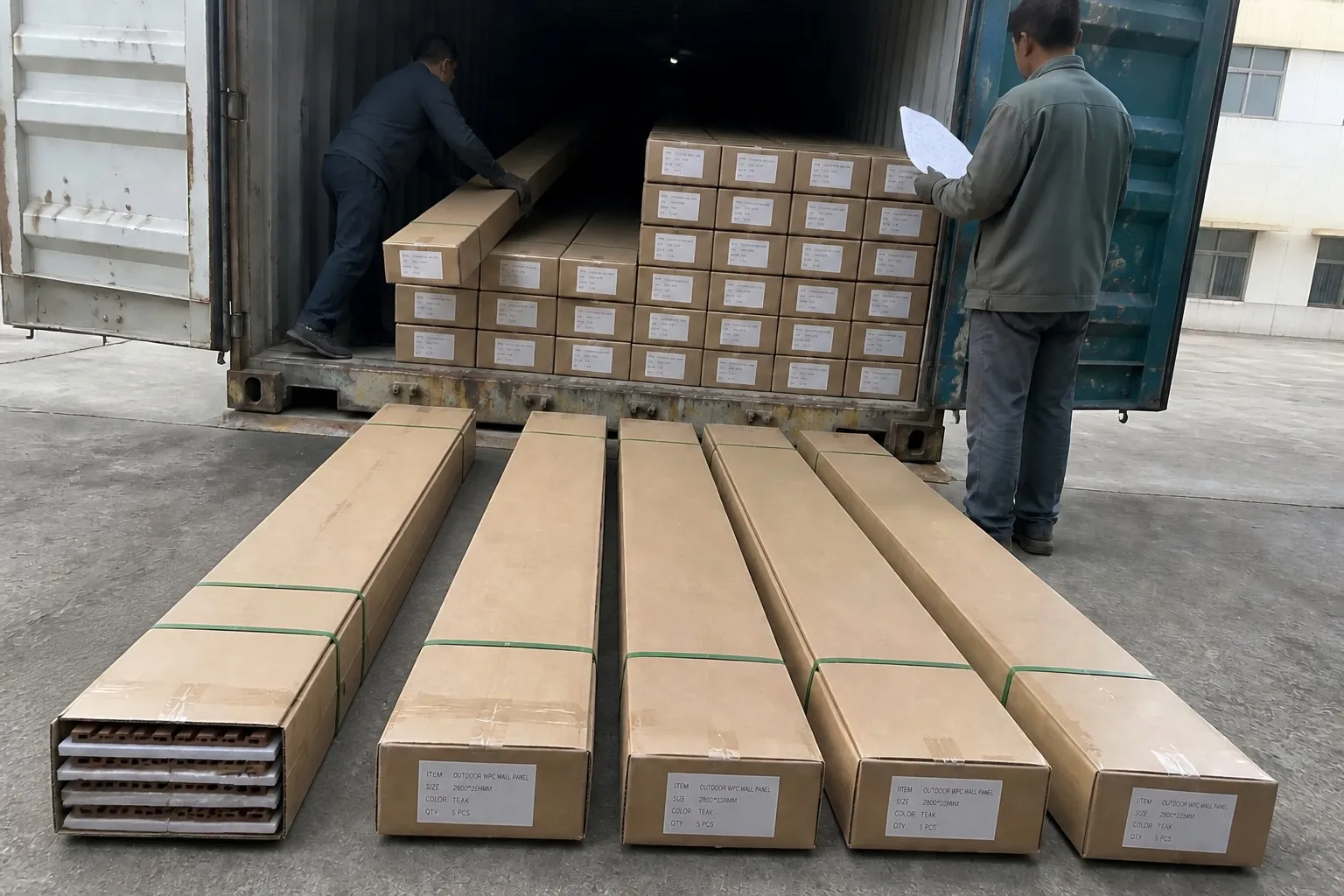
A pre-shipment inspection should occur when enough goods are complete and packed for a representative review. The inspection scope should match the purchase agreement.
I normally expect the review to cover:
- Product identity and ordered assortment
- Quantity and packaging count
- Dimensions and visual workmanship
- Surface and color against approved references
- Profile fit and accessory compatibility
- Carton labels and shipping marks
- Carton, pallet, and edge protection
- Container cleanliness and visible condition
- Loading pattern and load security
- Required documentation
WPC wall panels can occupy substantial volume relative to their value. Therefore, loading efficiency affects real purchasing cost[^5]. Panel length, carton dimensions, pallet use, and accessory packing can change container utilization. I ask the supplier or freight professional for a loading plan instead of assuming that a stated number of square meters will fit.
LCL shipping may be useful for smaller orders, but additional handling can increase packaging demands and damage exposure.[^6] FCL shipping can reduce transfer points, although it may not be economical for every order. A qualified freight forwarder should compare the practical options.
Shipping documents may include a commercial invoice, packing list, bill of lading, certificate of origin, insurance document, and market-specific records. Requirements vary by country and shipment. I advise buyers to confirm the HS classification, duty, taxes, labeling, and import documentation with a licensed customs broker or relevant authority. A supplier’s suggested code should not be accepted without local verification.[^7]
Step 10: Receive the goods and manage after-sales records
The buyer should inspect the shipment as soon as practical after arrival. Delays can make it harder to identify when damage occurred or to meet notice deadlines under the sales, insurance, carrier, or inspection agreement.[^8]
I recommend documenting:
- The sealed container or external shipment condition
- The seal number, where applicable
- Pallets and cartons before unloading
- Any water, crushing, puncture, or impact damage
- Product codes and batch references
- A representative sample of opened cartons
- Quantity differences or mixed items
- Installation-related concerns from a controlled trial area
If a problem appears, the buyer should preserve the goods and packaging while contacting the appropriate supplier, carrier, insurer, inspector, or adviser. A useful claim file can include photographs, videos, carton labels, batch numbers, quantity records, inspection findings, and a description of the requested remedy.
I also use the receiving stage to improve replenishment orders. The buyer can record which profiles sold well, which accessories were missing, how installers responded, and whether packaging was adequate. This information creates a better second purchase brief.
After-sales responsibility should be agreed before shipment. The parties should define the claim notification period, evidence needed, review procedure, and possible remedies. No supplier can assess a complaint fairly when the product identity, batch, storage conditions, installation method, and alleged defect are unknown.
Frequently Asked Questions
What documents should I request when importing WPC wall panels from China?
I usually request a commercial invoice, packing list, bill of lading, product specification, and relevant inspection or test records. A certificate of origin or additional declarations may also be required. Buyers should confirm exact customs, compliance, and labeling requirements with local authorities or qualified advisers.
Should I choose an EXW, FOB, CIF, or DDP quotation?
I choose the term according to the buyer’s logistics capability and the destination. FOB often provides a clear division for experienced importers, while CIF or DDP may appear simpler. However, buyers should compare included charges, exclusions, risks, and named locations rather than selecting an Incoterm only for convenience.
How can I verify a Chinese WPC wall panel manufacturer?
I verify the legal company identity, factory location, production processes, quality records, export history, sample quality, and ability to meet the specified profile. I may also use a video audit, factory visit, third-party audit, or pre-shipment inspection. No single certificate replaces complete supplier verification.
Is the lowest WPC wall panel price usually the best choice?
I do not treat the lowest unit price as the best offer. Product dimensions, composition, finish, packaging, loading efficiency, accessories, freight basis, inspection, and after-sales responsibilities can differ. I normalize these factors before comparing the estimated landed cost and supplier capability.
How long does a WPC wall panel order take to produce?
I confirm lead time for each specific order. Standard products may move faster than customized profiles, colors, or packaging. Our stated lead time is 7–14 days for many products, but raw materials, order volume, inspection, peak-season capacity, and shipping schedules can change the final timeline.
Conclusion
To import WPC wall panels from China successfully, I recommend treating sourcing as a ten-step risk-control process rather than a search for the lowest unit price. A clear brief, comparable quotations, controlled samples, documented QC, precise contracts, inspection, and careful receiving procedures reduce avoidable uncertainty. Local professionals should verify compliance, customs, and application-specific requirements. If you are evaluating WPC wall panel specifications, samples, OEM options, production controls, or export terms, contact our team with your purchase brief for a documented supplier proposal.
[^1]: "ISO - Certification", https://www.iso.org/certification.html. ISO guidance distinguishes management-system certification from product certification: certification to a management-system standard assesses organizational processes and does not by itself certify individual products or demonstrate approval under destination-market regulations. Evidence role: definition; source type: institution. Supports: ISO management-system certification evaluates an organization's management system rather than certifying each product or establishing regulatory market access.. Scope note: A management-system certificate may still be relevant evidence of process controls, depending on its scope and the certification body's accreditation. [^2]: "Know Your Incoterms", https://www.trade.gov/know-your-incoterms. The ICC Incoterms® 2020 rules assign different delivery points, cost allocations, and risk-transfer obligations to EXW, FOB, CIF, and DDP; quotations on those terms therefore require adjustment before like-for-like comparison. Evidence role: definition; source type: institution. Supports: Incoterms rules allocate delivery obligations, costs, and risk differently among EXW, FOB, CIF, and DDP.. Scope note: Incoterms rules do not determine all contract issues, including price composition, title transfer, payment terms, or product conformity. [^3]: "Business Email Compromise", https://www.fbi.gov/how-we-can-help-you/scams-and-safety/common-frauds-and-scams/business-email-compromise. Cybersecurity and law-enforcement guidance identifies altered vendor bank-account or payment instructions as a common business-email-compromise tactic and advises independent verification through a trusted communication channel. Evidence role: mechanism; source type: government. Supports: Business email compromise schemes can use altered vendor payment instructions to divert legitimate payments.. Scope note: An unexpected change is a risk indicator rather than proof of fraud; legitimate account changes can occur and should be verified. [^4]: "6.2.1. What is Acceptance Sampling?", https://www.itl.nist.gov/div898/handbook/pmc/section2/pmc21.htm. Acceptance-sampling guidance treats product quality as a lot-level assessment based on a defined sampling plan and inspection criteria; an observation of a single unit cannot by itself characterize the condition of an entire order. Evidence role: mechanism; source type: government. Supports: Lot acceptance decisions require a defined sampling and inspection approach rather than observations of isolated units.. Scope note: The appropriate sampling plan, acceptance threshold, and inspection level must be selected for the product, risk level, and contractual requirements. [^5]: "Publication: Logistics Costs and Competitiveness", https://openknowledge.worldbank.org/entities/publication/121bbfe8-e988-51c3-8b96-0e6126c9593d. Logistics research recognizes that cargo-space utilization and shipment configuration influence transport efficiency and the transport cost attributable to each unit of goods, making loading plans relevant to landed-cost calculations. Evidence role: mechanism; source type: institution. Supports: Transport and handling costs are influenced by cargo volume utilization and the shipment configuration used to move goods.. Scope note: The actual cost effect depends on freight rates, shipment mode, dimensional weight or container pricing, port charges, and the product's packaging configuration. [^6]: "Load Securement and Packaging Methods to Reduce Risk ...", https://repository.rit.edu/cgi/viewcontent.cgi?article=1008&context=japr. Freight-handling research describes consolidated shipments as involving consolidation and deconsolidation stages that can add handling events; additional handling makes adequate packaging and load protection important for damage prevention. Evidence role: mechanism; source type: research. Supports: Consolidated freight can involve additional transfer, consolidation, and deconsolidation handling, which makes packaging protection significant.. Scope note: Additional handling does not establish that LCL freight will be damaged, and the relative risk depends on carriers, terminals, packaging design, and cargo type. [^7]: "Harmonized System (HS) Codes", https://www.trade.gov/harmonized-system-hs-codes. Customs guidance explains that tariff classification must be determined under the importing jurisdiction's tariff system and that importers can seek official classification advice or binding rulings where available; supplier-provided codes should therefore be independently checked. Evidence role: general_support; source type: government. Supports: Tariff classification is determined under customs rules and importers may seek an official classification ruling or guidance from the customs authority.. Scope note: Procedures for rulings, the legal responsibility for declarations, and the binding effect of a classification decision vary by customs jurisdiction. [^8]: "Contracts for the carriage of goods by sea and multimodal ...", https://unctad.org/system/files/official-document/dtltlbinf2022d1_en.pdf. Transport and cargo-claims guidance generally emphasizes prompt inspection, preservation of damaged goods and packaging, and timely notice, because delay can weaken evidence concerning the time and cause of loss and may affect contractual claim procedures. Evidence role: general_support; source type: institution. Supports: Prompt inspection, documentation, and notice are relevant to preserving evidence and pursuing cargo-damage claims.. Scope note: Applicable notice periods and legal consequences depend on the governing contract, insurance policy, carriage convention, and jurisdiction.