

Eco-friendly wall panels now appear frequently in the inquiries I receive from importers and distributors. However, vague green claims can expose wholesalers to unsuitable products, customer disputes, and regulatory questions. I recommend a simpler approach: define the application first, examine the evidence behind each claim, and confirm that the panel still meets essential performance requirements.
Eco-friendly wall panels should be evaluated claim by claim rather than accepted under one broad “green” label. Wholesalers should verify the exact product model, destination market, intended application, test scope, and supporting documents. They should also assess fire performance, durability, installation, maintenance, and commercial suitability before placing an order.

I have found that the hardest part is rarely collecting certificates. The real challenge is connecting each document to the correct product and sales claim. A structured review helps wholesalers separate useful environmental evidence from marketing language that may create downstream risk.
What Does “Eco-Friendly” Mean for Wall Panels?
The term sounds simple, but it can describe several unrelated product characteristics. This creates a problem for wholesalers because one environmental advantage may be interpreted as proof of many others. I encourage buyers to divide the term into specific, testable claims before comparing products or suppliers.
Eco-friendly wall panels may have low measured emissions, recycled or natural content, reduced material use, recyclable components, or other documented attributes. These characteristics are not interchangeable.[^1] A panel with low emissions is not automatically recyclable, and a panel containing natural material is not automatically non-toxic, low-carbon, or suitable for every building application.[^2]
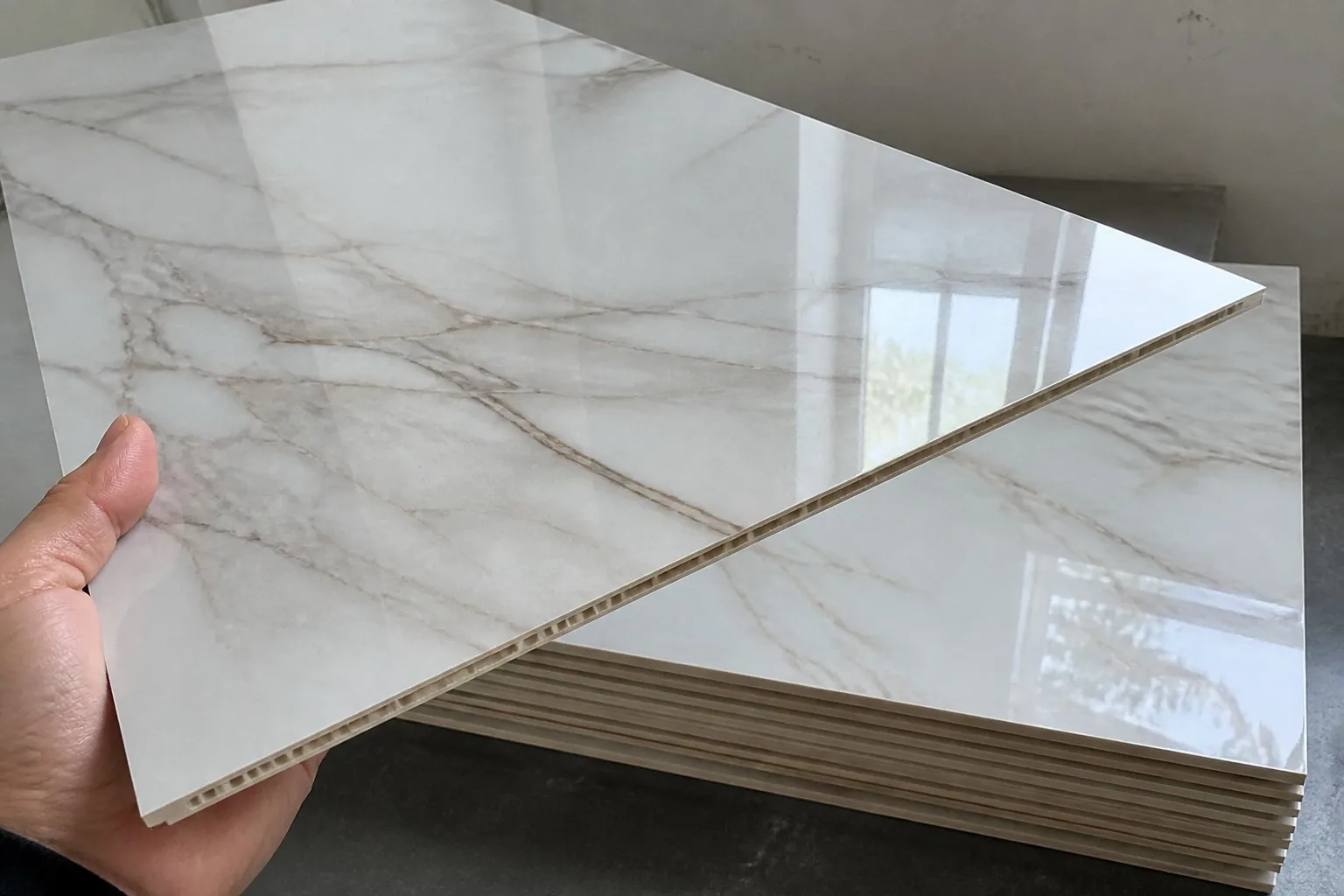
Separate the Claims Before Reviewing the Evidence
I usually ask buyers what they mean when they request an “eco-friendly” panel. The answer often reveals that they are actually looking for one of the following:
- Low emissions: The buyer wants evidence concerning emissions of specified substances under a stated test method.
- Recycled content: The buyer wants to know whether pre-consumer or post-consumer recycled material is present.
- Natural content: The buyer prefers products containing minerals, fibers, wood-derived ingredients, or other naturally sourced materials.
- Recyclability: The buyer wants to know whether the product can enter an available recovery or recycling stream after use.
- Material safety: The buyer wants specific substances assessed under an applicable standard or regulation.
- Resource efficiency: The buyer wants a lightweight or thin panel that may reduce raw-material use or shipping weight.
- Long service life: The buyer wants durable finishes that may reduce the frequency of replacement.
Each claim needs different evidence. A composition statement cannot replace an emissions report. Likewise, a laboratory report for one substance cannot prove that a finished panel is broadly “non-toxic.”
| Environmental claim | Evidence a buyer may request | Important limitation to check |
|---|---|---|
| Low emissions | Test report under a named method | Product model, specimen, test conditions, date, and pass criteria |
| Recycled content | Supplier declaration or third-party verification | Percentage, material source, and calculation method |
| Natural content | Bill of materials or composition declaration | “Natural” does not automatically establish safety or sustainability |
| Recyclability | Material identification and recovery guidance | Local recycling infrastructure may not accept the product |
| Restricted substances | Test report or conformity documentation | Covered substances, legal market, and model scope |
| Long service life | Durability tests, warranty terms, or project records | Installation and exposure conditions can change performance |
I once received an inquiry that simply asked, “Do you have an environmental certificate?” The buyer had not yet specified the country, wall location, panel type, or intended claim. I could have sent a folder of documents, but that would not have answered the real purchasing question. We first narrowed down the product and application, and only then identified which documents were relevant.
I treat “eco-friendly” as the beginning of a technical discussion, not the end of one.
Wholesalers should apply the same discipline in catalogs and online listings. Narrow claims such as “tested for specified emissions under a named method” are generally easier to support than phrases such as “completely green,” “chemical-free,” or “100% safe.” Buyers should obtain qualified regulatory or technical advice before publishing claims in a particular market.
How Should Wholesalers Verify Eco-Friendly Wall Panels?
Document volume can create a false sense of security. A supplier may provide several reports, but those reports may cover another model, an old formulation, or a test that does not support the intended claim. I recommend checking traceability before judging the strength of the environmental message.
Wholesalers should verify eco-friendly wall panels by matching every certificate, declaration, and test report to the supplier, factory, exact model, material composition, destination market, and intended use. Buyers should review issuing bodies, dates, test methods, sample descriptions, results, exclusions, and document validity with qualified professionals where necessary.

Begin With the Product, Market, and Application
I use three questions at the start of a document review:
- Where will the product be sold?
- Where and how will the panel be used?
- Which exact model, thickness, finish, and construction will be supplied?
These questions prevent buyers from evaluating documents in isolation. A report may be credible, but it can still be irrelevant to a specific order.
For example, a result for an interior decorative panel should not automatically be applied to an exterior cladding product. A test for one thickness may not cover every thickness. A report for a base panel may not include a newly added coating, adhesive, printed film, or surface treatment.
Use a Document-Matching Checklist
I recommend recording the following information for every report:
- Legal name of the applicant or manufacturer
- Manufacturing location, if stated
- Product name and model number
- Panel thickness and construction
- Surface film, coating, adhesive, or backing
- Sample selection method
- Test standard and edition
- Testing laboratory or certification body
- Test date and report number
- Measured results and pass criteria
- Intended market or regulatory framework
- Limitations, exclusions, and expiry information
- Permission to use certification marks or claims
A supplier’s ISO certificate may help a buyer evaluate the documented scope of its management system. However, an ISO management-system certificate does not automatically certify every product as environmentally preferable[^3]. Buyers should examine the named organization, factory address, activity scope, issuing body, and validity period.
Match Samples to Production
The next step is production control. I encourage buyers to ask how the tested specimen relates to current mass production. Useful questions include:
- Has the formulation changed since testing?
- Do raw-material substitutions require approval?
- Does the supplier retain production samples?
- Does incoming inspection cover key materials?
- Are batch codes recorded?
- Can the factory provide pre-shipment inspection records?
- Can an independent inspector sample from the actual order?
At our factory, we use in-house quality-control procedures and aim for consistent batch production across our wall-panel lines. However, I still recommend that importers agree on specifications, tolerances, inspection criteria, and third-party testing when the project risk justifies it. A manufacturer’s internal controls and statements should support—not replace—independent verification.
Can Eco-Friendly Wall Panels Meet Project-Performance Requirements?
Environmental messaging can attract a customer, but it cannot make an unsuitable panel perform correctly. If a product fails the project’s fire, moisture, impact, installation, or maintenance requirements, its environmental attributes will not solve the problem. I therefore keep task fit at the center of procurement decisions.
Eco-friendly wall panels must satisfy both environmental objectives and application-specific performance requirements. Wholesalers should assess fire behavior, water exposure, dimensional stability, impact resistance, substrate compatibility, installation method, cleaning, expected service life, and local compliance. Qualified professionals should confirm requirements for regulated or safety-critical projects.
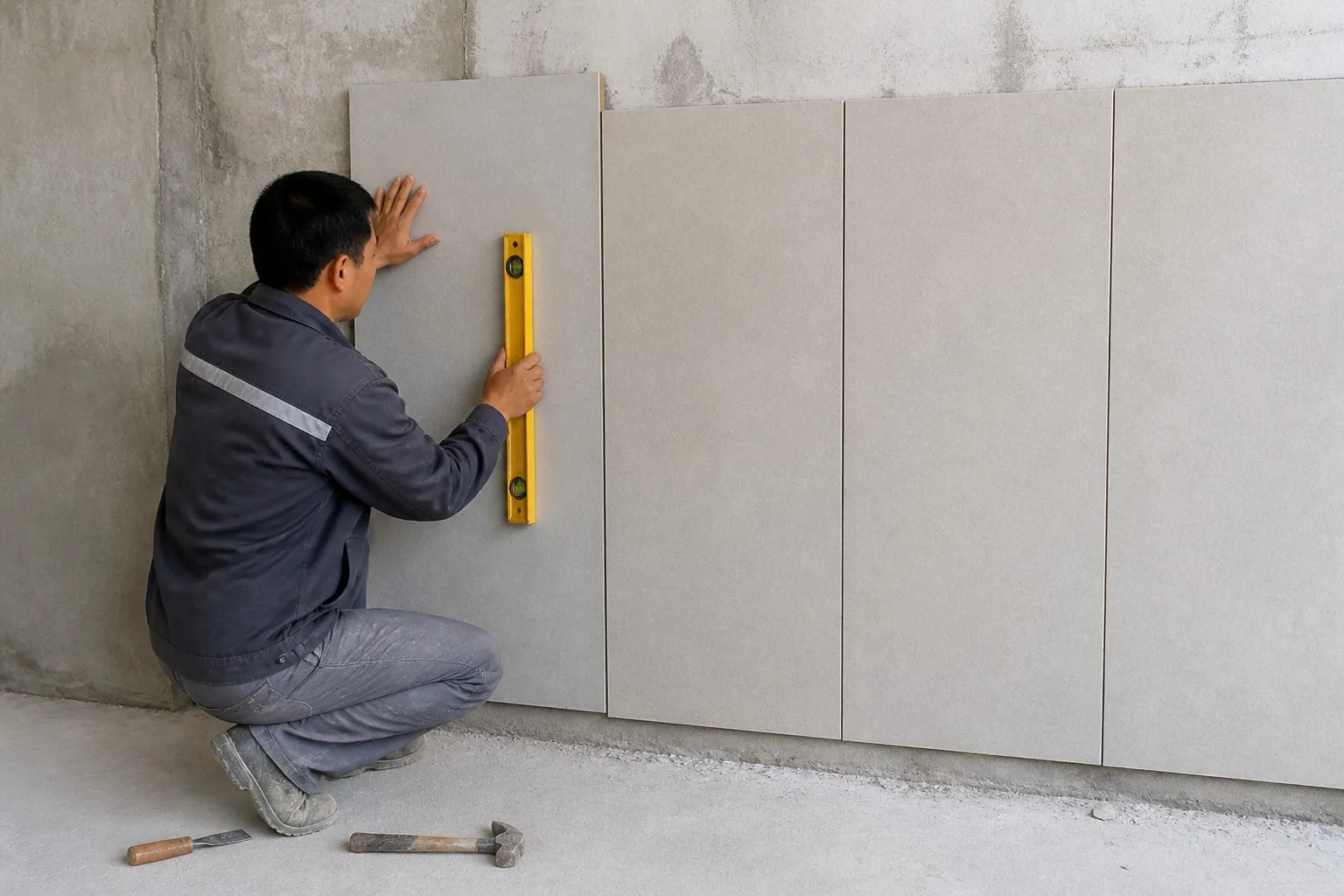
Use a Two-Layer Evaluation
I separate a panel review into two layers.
Layer one covers task performance:
- Interior or exterior use
- Residential, commercial, hospitality, or public-space use
- Expected temperature and humidity
- Water or weather exposure
- Fire-performance requirements
- Impact and abrasion risk
- Substrate condition
- Installation system
- Cleaning chemicals
- Repair and replacement needs
Layer two covers environmental claims:
- Emissions
- Material composition
- Recycled content
- Restricted substances
- Packaging
- Transport efficiency
- End-of-life options
The first layer determines whether the product can do the job. The second layer helps the buyer choose between otherwise suitable products.
Fire Requirements Can Override General Green Positioning
A Korean buyer once approached us about a decorative wall product and initially focused on its environmental selling points. During the discussion, the buyer identified a particular project requirement for a stated level of fire performance, described in that inquiry as “Class A or above.”
That phrase could not be treated as a universal rule. Fire classifications depend on the relevant jurisdiction, test standard, product configuration, installation method, and project type.[^4] We therefore had to bring the conversation back to the exact standard and required evidence. The example showed why wholesalers should never assume that a broad class description has the same meaning across markets.
I advise buyers to verify:
- The applicable fire test method
- The classification system and required level
- Whether the result covers the finished panel
- Whether adhesive, joints, substrate, and mounting affect the assembly[^5]
- Whether the report covers the supplied thickness
- Whether local authorities or project consultants require additional evidence
Compare Performance by Intended Use
| Requirement | Interior decorative wall | Wet-area wall | Commercial public area | Exterior cladding |
|---|---|---|---|---|
| Emissions review | Often important | Often important | Often important | Depends on market and system |
| Moisture resistance | Moderate | High | Application-dependent | High |
| UV and weather resistance | Usually limited concern | Limited concern | Application-dependent | Critical |
| Fire documentation | Project-dependent | Project-dependent | Often closely reviewed | System- and code-dependent |
| Impact resistance | Use-dependent | Use-dependent | Often important | Important |
| Installation control | Important | Critical at joints | Important | Critical for the full system |
| Maintenance planning | Routine | Cleaning and sealing | High-traffic cleaning | Weathering and inspection |
Wholesalers should not use this table as a compliance standard. I present it as a screening tool. Architects, fire consultants, laboratories, engineers, and local authorities should evaluate application-specific requirements.
Which Wall-Panel Types Should Wholesalers Compare?
A buyer may understand the environmental claim but still select the wrong product family. Flexible veneer, UV marble-style boards, SPC panels, flooring products, and outdoor cladding systems have different constructions and use conditions. I advise wholesalers to compare them by application rather than appearance alone.
Wholesalers should compare panel types according to substrate conditions, weight, rigidity, moisture exposure, impact risk, installation method, design range, maintenance, and required documentation. No product category is automatically the most sustainable or suitable. The strongest choice is the documented option that performs reliably in its intended setting.
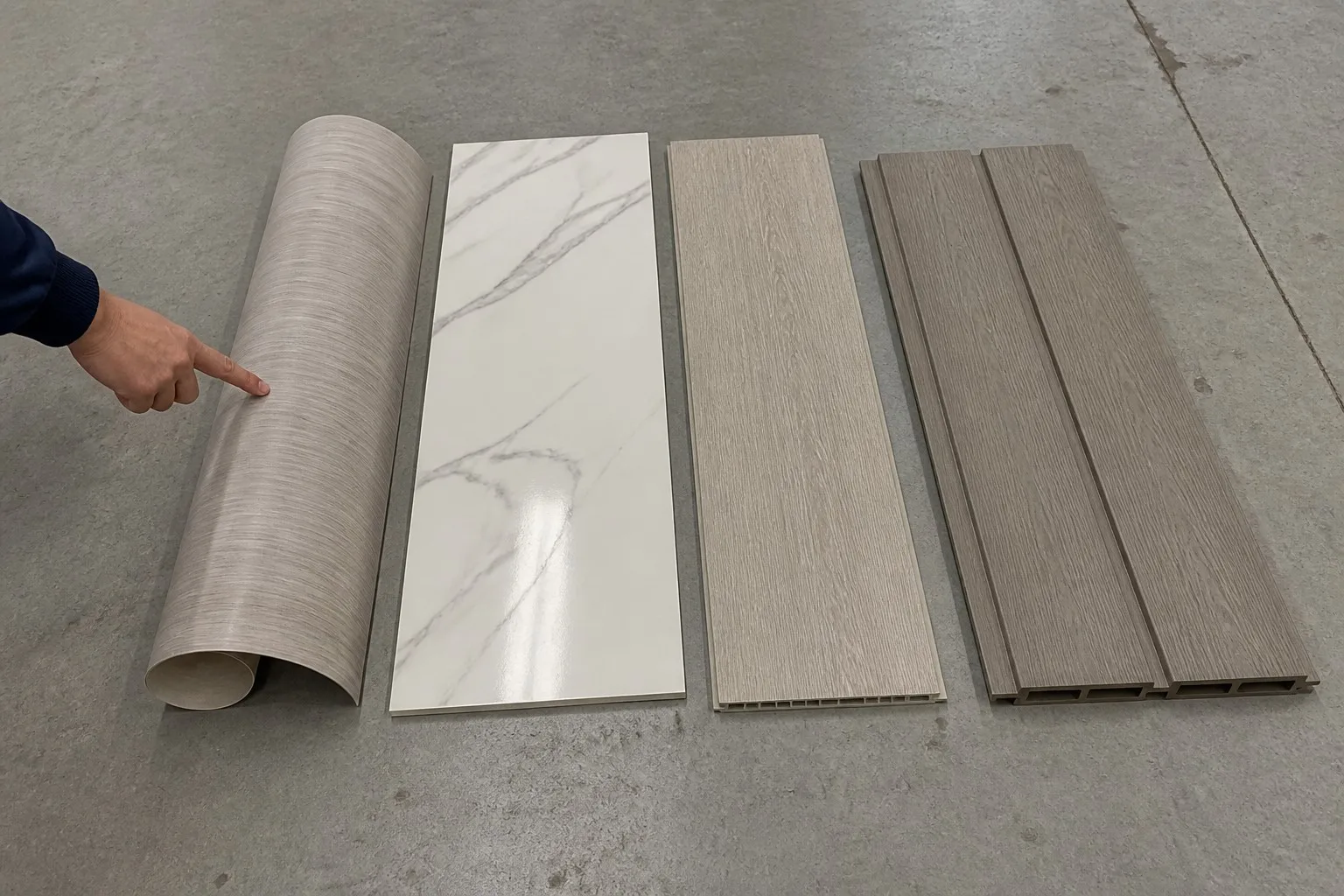
Build a Category-Level Shortlist
Our four main product lines illustrate why category distinctions matter:
| Product category | Typical purchasing interest | Questions wholesalers should ask |
|---|---|---|
| Soft Stone flexible veneer | Lightweight decorative finishes and curved or renovation surfaces | What is the composition, flexibility range, backing, adhesive requirement, and suitable exposure? |
| UV Marble Board | High-gloss or stone-look interior decoration | What is the core material, surface coating, scratch resistance, thickness, and installation method? |
| SPC Wall Panels and Flooring | Dimensional consistency and decorative surface options | What is the core formulation, wear layer, locking or mounting system, and intended wall or floor use? |
| Outdoor Wall Cladding | Exterior appearance and weather exposure | What is the system design, UV resistance, fixing method, drainage approach, and maintenance plan? |
These descriptions are general. Buyers should confirm the exact technical data for each model because products within the same family can differ.
Consider the Whole Installed System
I often see procurement teams focus on the visible panel while overlooking the accessories. However, the installed wall may also include:
- Adhesives
- Mechanical fasteners
- Battens or framing
- Joint profiles
- Sealants
- Corner trims
- Backing boards
- Moisture barriers
- Protective coatings
These components can affect installation quality, fire behavior, moisture management, repairability, and the claims a distributor can responsibly make. A panel report may not represent the complete assembly.[^6]
Account for Logistics Without Overclaiming
Lightweight or thin panels may reduce shipment weight or allow more square meters per container than heavier alternatives. That can be commercially useful. However, I avoid describing a product as “low carbon” based only on weight. A carbon claim would require a defined boundary, data, calculation method, and often independent assessment.[^7]
Wholesalers can still compare practical logistics data:
- Square meters per carton
- Carton dimensions
- Net and gross weight
- Pallets per container
- Breakage allowance
- Protective packaging
- Mixed-color loading options
- Replacement stock requirements
Our standard lead time is generally 7–14 days for many products, subject to model, customization, quantity, and production scheduling. Our MOQ can start from 30 pieces for selected products, although the exact minimum varies. We also support FOB, CIF, and DDP arrangements where feasible. Buyers should confirm current terms in a formal quotation.
I recommend ordering samples before committing to a container. Buyers can compare appearance, flexibility, edge quality, surface consistency, odor, installation behavior, and packaging. Samples do not replace laboratory testing, but they often reveal practical issues that documents cannot show.
How Can Wholesalers Control Environmental Marketing Risk?
A well-supported product can still create risk if a distributor exaggerates its benefits. Broad phrases may travel from a factory presentation into catalogs, sales scripts, and online listings without their original limitations.[^8] I encourage wholesalers to control the wording as carefully as they control the physical product.
Wholesalers can reduce environmental marketing risk by creating an approved claim sheet for every product model. Each claim should link to supporting evidence and include its scope, date, market, and limitations. Sales teams should avoid absolute terms unless qualified legal and technical reviewers confirm that the evidence supports them.[^9]

Create a Claim-Evidence Matrix
A simple internal matrix can prevent sales teams from making unsupported statements.
| Proposed claim | Supporting document | Approved wording | Restriction |
|---|---|---|---|
| Tested for specified emissions | Named test report | Use the precise tested substance and method | Do not expand to “emission-free” |
| Contains recycled material | Verified declaration | State the documented percentage and basis | Do not imply full recyclability |
| Suitable for exterior use | Technical specification and relevant tests | Name the approved application | Follow installation and exposure limits |
| Meets a stated fire classification | Valid report for the supplied configuration | Quote the exact standard and classification | Do not translate it into another market’s class |
| Produced under an ISO-certified system | Current certificate with relevant scope | Describe the management-system scope accurately | Do not call it product environmental certification |
Control Claims Across Sales Channels
I recommend reviewing environmental wording in:
- Product catalogs
- E-commerce listings
- Private-label packaging
- Installation manuals
- Social media posts
- Sales presentations
- Distributor training materials
- Tender submissions
- Project submittals
- Customer quotations
OEM and private-label customers face particular risk because their brand appears on the final product. They should approve the product specification, claim wording, artwork, and supporting-document package before printing.
Include Change-Control Terms
Environmental evidence can lose relevance when a product changes. A practical supplier agreement can require notification before changes to:
- Core raw materials
- Additives or stabilizers
- Surface films
- Coatings
- Adhesives
- Backing layers
- Manufacturing location
- Product thickness
- Key component suppliers
- Packaging claims
I also recommend using a signed specification sheet and an agreed sample. Pre-shipment inspection can then compare dimensions, color, finish, packaging, quantity, and other measurable criteria against the approved order.
No checklist removes every risk. Market rules and project requirements can change, and document interpretation may require specialist knowledge. Wholesalers should seek advice from accredited laboratories, certification bodies, building-code consultants, environmental specialists, or legal professionals when a claim affects compliance or public safety.
Frequently Asked Questions
Are eco-friendly wall panels always recyclable?
No. Recyclability depends on the panel’s composition, bonded layers, coatings, contamination, disassembly method, and local collection infrastructure.[^10] A technically recyclable material may not have a practical recycling route in the destination market.[^11] Wholesalers should request precise end-of-life information and avoid making universal recycling claims.
Does an ISO certificate prove that a wall panel is environmentally friendly?
No. An ISO certificate should be interpreted according to its exact standard and stated scope. A management-system certificate may provide useful information about factory processes, but it does not automatically certify a specific wall panel, environmental benefit, emissions result, or legal compliance claim.
Which documents should wholesalers request from a wall-panel supplier?
I suggest requesting a product specification, composition information where available, relevant test reports, management-system certificates, installation guidance, warranty terms, quality-control records, and packaging data. Buyers should only request documents that relate to the exact model, destination market, application, and claims under review.
Can a test report for one model cover all panel colors and thicknesses?
Not necessarily. Different thicknesses, coatings, films, colors, adhesives, or core formulations may affect the relevance of a report.[^12] Wholesalers should check the sample description and scope. If coverage is unclear, they should ask the laboratory, certification body, or another qualified professional for confirmation.
How should I assess a new wall-panel supplier?
I recommend reviewing business credentials, factory capabilities, quality-control procedures, test-document traceability, production lead times, minimum order quantities, customization controls, export experience, and complaint handling. Buyers should also order samples, define inspection criteria, and consider an independent factory audit or pre-shipment inspection.
Conclusion
The rise of eco-friendly wall panels gives wholesalers more ways to respond to customer priorities, but a green label cannot replace disciplined procurement. I recommend defining the market, application, and exact model first. Buyers should then match every environmental claim to relevant evidence while also checking fire performance, durability, installation, maintenance, and production consistency.
We manufacture customizable interior and exterior wall solutions for B2B buyers in more than 50 countries. Contact us to discuss your target market, required application, specifications, MOQ, documentation needs, and sample order before choosing a panel for wholesale distribution.
[^1]: "Green Guides", https://www.ftc.gov/news-events/topics/truth-advertising/green-guides. Environmental-claims guidance distinguishes recycled content, recyclability, emissions, and other product attributes as separate representations, each requiring evidence appropriate to the specific claim. Evidence role: definition; source type: government. Supports: Environmental marketing claims such as recycled content, recyclability, and emissions-related attributes are distinct claims that require claim-specific substantiation.. Scope note: The guidance addresses environmental claims generally rather than wall panels specifically. [^2]: "Volatile Organic Compounds' Impact on Indoor Air Quality", https://www.epa.gov/indoor-air-quality-iaq/volatile-organic-compounds-impact-indoor-air-quality. Life-cycle assessment and product-safety frameworks evaluate emissions, chemical properties, environmental impacts, and functional performance as distinct dimensions; evidence for one dimension does not by itself establish the others. Evidence role: general_support; source type: institution. Supports: Product emissions, chemical hazard, life-cycle environmental impact, and application performance are evaluated using different evidence and cannot generally be inferred from a single material attribute.. Scope note: This is a general methodological principle and does not assess any named wall-panel model. [^3]: "ISO 14001 explained", https://www.iso.org/home/insights-news/resources/iso-14001-explained.html. ISO 14001 specifies requirements for an environmental management system; certification to the standard indicates conformance of that management system and is not, by itself, product environmental certification. Evidence role: definition; source type: institution. Supports: ISO 14001 certification concerns an organization's environmental management system rather than certification of the environmental performance of individual products.. Scope note: The certificate's precise scope, site coverage, and accredited certification status still require document-level review. [^4]: "ASTM E84 Explained: Flame Spread, Class A Ratings & ...", https://starcsystems.com/blog/astm-e-84-fire-rating-your-questions-answered/. Fire classifications are assigned under particular test and classification systems, so a designation such as “Class A” must be read with its governing standard, product scope, and applicable code requirements. Evidence role: definition; source type: government. Supports: Fire-performance classifications are tied to specified test methods and classification systems and must be interpreted in the applicable regulatory context.. Scope note: The applicable classification and acceptance criteria vary by jurisdiction and project. [^5]: "ACM Cladding and NFPA 285: Fire Compliance Guide for ...", https://www.dextall.com/blog/acm-cladding-nfpa-285-high-rise. Fire-test and classification practice recognizes that the reaction-to-fire performance of wall linings and cladding may depend on the tested product configuration, substrate, fixings, joints, and end-use conditions. Evidence role: mechanism; source type: research. Supports: The fire performance of a lining or cladding can be influenced by its substrate, fixing method, joints, adhesives, and other features of the installed assembly.. Scope note: The relevance of any factor must be determined under the applicable test standard and for the exact installed system. [^6]: "Improving the Energy Performance of the Building ...", https://impact.ornl.gov/en/publications/improving-the-energy-performance-of-the-building-envelope-through/. Building-science guidance notes that component test results may not establish whole-assembly performance when interfaces, substrates, fasteners, barriers, and installation conditions differ from the tested configuration. Evidence role: general_support; source type: education. Supports: Building-product performance is often dependent on the complete assembly and installation conditions rather than on a component tested in isolation.. Scope note: The extent to which an assembly test is required depends on the performance property, governing standard, and local code. [^7]: "ISO 14067: Meaning, Standard and Requirements", https://greenly.earth/en-us/blog/company-guide/iso-14067-meaning-standard-and-requirements. Product carbon-footprint standards require the practitioner to define the system boundary and calculation method, use documented activity and emission-factor data, and report assumptions transparently; verification is a separate assurance activity where used. Evidence role: mechanism; source type: institution. Supports: Product carbon-footprint calculations require defined system boundaries, data collection, methodological choices, and transparent reporting; independent verification may increase credibility.. Scope note: A formal verification requirement depends on the program, market, and type of claim. [^8]: "Green Guides", https://www.ftc.gov/news-events/topics/truth-advertising/green-guides. Consumer-protection guidance on environmental marketing cautions that broad, unqualified environmental benefit claims may be deceptive when the evidence supports only limited or conditional product attributes. Evidence role: expert_consensus; source type: government. Supports: Environmental claims should be clear, specific, substantiated, and qualified where necessary, rather than presented as broad unqualified benefits.. Scope note: The legal effect of such guidance depends on the jurisdiction and the exact wording and context of the claim. [^9]: "Green Guides", https://www.ftc.gov/news-events/topics/truth-advertising/green-guides. Environmental-marketing guidance requires claims to be truthful, substantiated, and sufficiently qualified to prevent consumers from inferring broader benefits than the supporting evidence demonstrates. Evidence role: general_support; source type: government. Supports: Environmental representations must be substantiated and should not overstate the scope or certainty of the available evidence.. Scope note: Specific review procedures and legal standards differ among destination markets. [^10]: "Trends in the secondary plastics markets: Global ...", https://www.oecd.org/en/publications/2022/02/global-plastics-outlook_a653d1c9/full-report/component-9.html. Recycling outcomes depend on product composition and separability together with the availability and capability of local collection, sorting, and reprocessing systems. Evidence role: mechanism; source type: institution. Supports: Whether an item is recycled in practice depends on material composition and design as well as collection, sorting, processing capacity, and contamination.. Scope note: The source may discuss material products broadly rather than composite wall panels in particular. [^11]: "Plastic pollution is growing relentlessly as waste ...", https://www.oecd.org/en/about/news/press-releases/2022/02/plastic-pollution-is-growing-relentlessly-as-waste-management-and-recycling-fall-short.html. International waste-management guidance recognizes that technical recyclability alone does not ensure actual recycling, which also requires effective collection, sorting, processing, and market infrastructure. Evidence role: general_support; source type: institution. Supports: Technical potential for recycling differs from actual recycling where local collection, sorting, processing, and end-market capacity are unavailable.. Scope note: Actual availability must still be verified in the relevant destination market and for the specific product construction. [^12]: "ISO/IEC 17025:2017, Section 7.8 - Reporting of Results", https://www.nist.gov/document/sop-1-calibration-certificate-eval-app-b-c-20190506pdf. Testing-laboratory practice requires reports to identify the tested item and conditions, and results should not be extended to materially different constructions, thicknesses, coatings, adhesives, or formulations without justified scope coverage. Evidence role: general_support; source type: institution. Supports: Laboratory results apply to the identified test item and conditions; changes in product construction or composition may require confirmation of applicability or additional testing.. Scope note: Whether a variation is material must be assessed under the relevant standard and by the laboratory or certification body.